
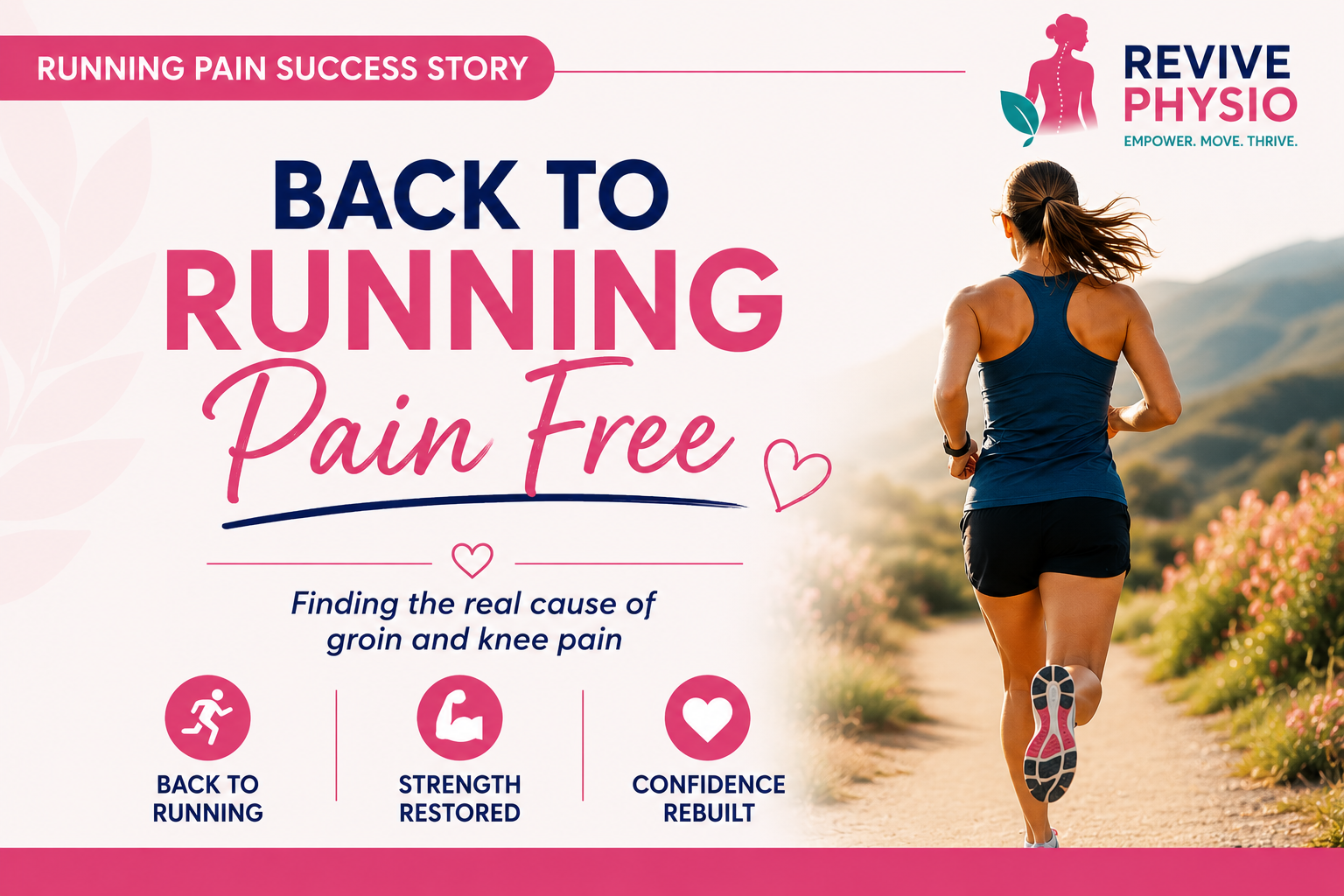
FROM SEVERE PAIN WHEN RUNNING TO BEING ABLE TO RUN PAIN FREE AGAIN
THE PROBLEM
After enjoying running for over six years, this patient began noticing a slight tightness in her left hamstring.
Initially it seemed minor. She continued training and even had a sports massage, but no obvious cause could be found.
Three weeks before her half marathon, she developed pain deep in the right groin together with pain along the inside and outside of her knee.
Despite the discomfort, she completed the race using supportive taping.
Everything changed at around 11½ miles.
Running downhill triggered severe pain and tingling into her leg, leaving her unable to walk for several minutes before the symptoms gradually settled enough for her to finish the race.
Although she recovered reasonably well afterwards, every attempt to return to running brought the pain back.
Even shorter runs caused a dull ache in the groin and knee, while hill training left her feeling as though her legs had "no strength."
She was worried that something serious was wrong and feared she might have to stop running altogether.
WHAT WE FOUND
A detailed physiotherapy assessment showed the knee wasn't actually the source of the problem.
Instead we identified:
✔ Sacroiliac joint dysfunction
✔ Reduced lumbar spine mobility
✔ Pelvic instability
✔ Neural tension affecting the right leg
✔ Movement patterns placing increased stress through the groin and knee
This explained why pain was appearing in several different areas despite the knee itself being structurally healthy.
TREATMENT
Treatment focused on restoring normal movement and addressing the underlying cause rather than simply treating the painful areas.
Her rehabilitation included:
✔ Hands-on physiotherapy
✔ Lumbar spine and pelvic mobilisations
✔ Manual therapy
✔ Pelvic stability exercises
✔ Progressive strengthening programme
✔ Postural and movement retraining
✔ Advice on returning to running safely
✔ Kinesiology taping
As her symptoms improved, exercises were progressed to rebuild strength, confidence and running capacity.
THE OUTCOME
Over the following weeks she made excellent progress.
On holiday she comfortably walked between 10,000 and 17,000 steps a day, including trail walks, without any recurrence of her symptoms and has returned to running 5-7 miles comfortably with no issue and more importantly no pain!
On reassessment:
✔ Pelvic alignment had been restored.
✔ Sacroiliac joint dysfunction had resolved.
✔ Lumbar spine mobility had returned to normal.
✔ No muscular trigger points remained.
Most importantly, she had regained confidence in her body and was back doing the activities she loves.
THE TAKE HOME MESSAGE
Pain isn't always where the problem starts.
Groin pain, knee pain and IT band symptoms in runners are often linked to movement problems around the pelvis, hips or lower back rather than the knee itself.
Identifying the true cause allows treatment to focus on fixing the problem instead of simply chasing the symptoms.
If running has become painful, don't ignore it or simply hope it will settle on its own.
Early physiotherapy assessment can often identify the underlying cause and help you return to running safely and with confidence.
Looking for treatment for a running injury?
At Revive Women's Physio & Wellbeing Clinic in Mosley Common, I help runners of all abilities recover from groin pain, knee pain, IT band syndrome, hamstring injuries, lower back pain and other running-related injuries.
Whether you're training for your first 5K or your next half marathon, my aim is to help you get back to doing what you love—stronger, more confident and pain free.