Desk-Based Jobs and Pain: Why Sitting All Day Is Hurting More Than Just Your Back
If you spend most of your day sitting at a desk, you're not alone.
Whether you're working from home, in an office, or hot-desking between locations, prolonged sitting is one of the most common reasons people seek physiotherapy treatment.
Many people assume their pain is caused by "poor posture" alone, but the reality is often much more complex.
As a physiotherapist with over 22 years of experience, I regularly help people struggling with neck pain, shoulder pain, headaches, back pain and stiffness linked to desk-based work.
Why Does Desk Work Cause Pain?
The human body was designed to move.
When we sit in one position for hours at a time, muscles, joints and nerves are placed under continuous stress.
Common problems include:
Tight chest muscles from rounded shoulders
Weakness in the upper back and core
Increased tension through the neck and shoulders
Reduced spinal mobility
Increased pressure through the lower back
Reduced circulation and movement
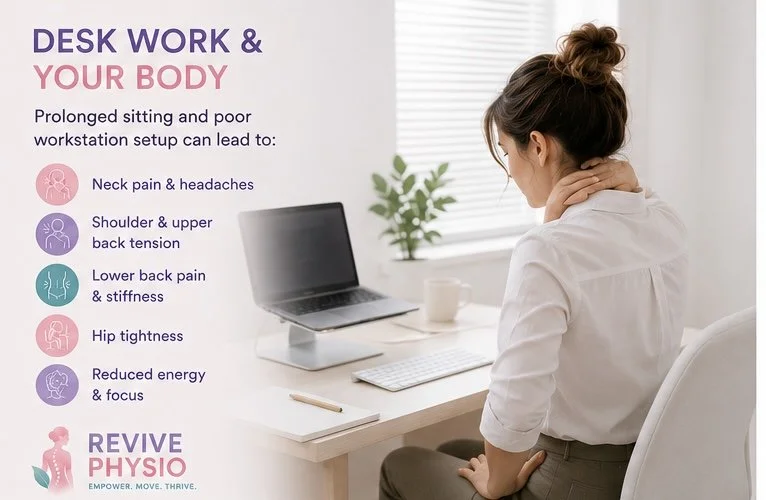
Over time this can lead to:
✔ Neck pain
✔ Shoulder pain
✔ Headaches
✔ Upper back stiffness
✔ Lower back pain
✔ Hip tightness
✔ Reduced energy levels
Is It Really Bad Posture?
Not always.
There is no such thing as a perfect posture.
The biggest problem is usually staying in one position for too long.
Even a good posture becomes a bad posture if maintained for hours without movement.
Your body thrives on variety.
How To Set Up Your Desk Correctly
A few simple adjustments can make a huge difference.
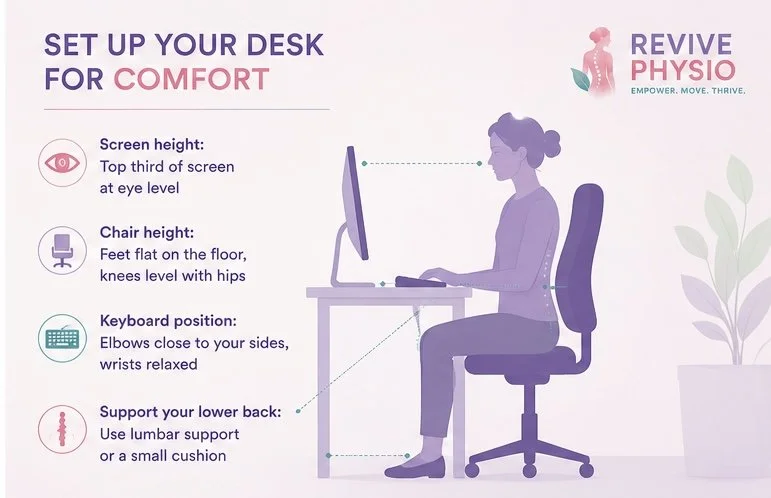
Screen Height
Your eyes should naturally look at the top third of the screen.
If you're using a laptop, consider a laptop stand and separate keyboard.
Chair Height
Your feet should rest comfortably on the floor.
Knees should be roughly level with your hips.
Keyboard Position
Keep elbows relaxed by your side.
Avoid reaching forwards.
Mouse Position
Keep the mouse close to your body.
Avoid constantly reaching out to the side.
Support Your Lower Back
Use the chair's lumbar support or a small cushion if needed.
Simple Exercises You Can Do At Your Desk
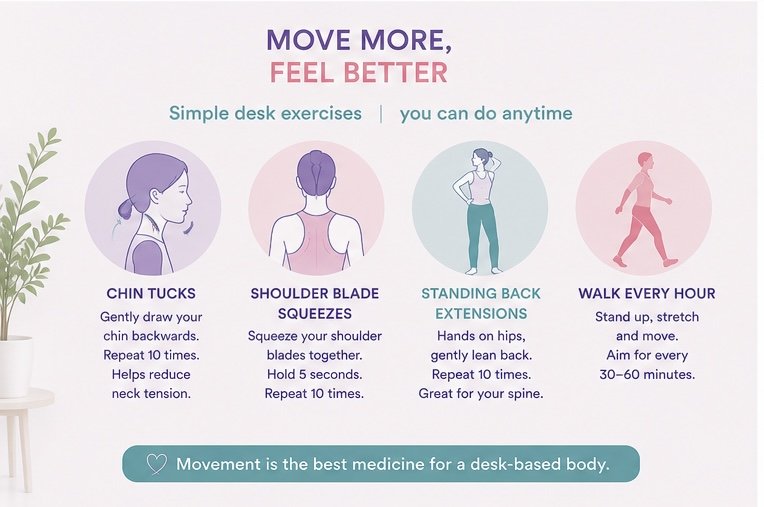
Chin Tucks
Gently draw your chin backwards as if making a double chin.
Repeat 10 times.
Helps reduce neck tension.
Shoulder Blade Squeezes
Pull your shoulder blades gently together.
Hold for 5 seconds.
Repeat 10 times.
Helps counteract rounded shoulders.
Standing Back Extensions
Stand up and place hands on hips.
Gently lean backwards.
Repeat 10 times.
Helpful for people sitting for prolonged periods.
Walk Every Hour
The most effective exercise is often the simplest.
Aim to stand and move every 30–60 minutes.
Why Does Pain Often Feel Worse During Perimenopause?
Many women notice that neck pain, back pain and joint stiffness become worse during their 40s and 50s.
Changes in oestrogen can affect:
Tendons
Ligaments
Muscle recovery
Joint lubrication
Sleep quality
This can make desk-related aches and pains feel more intense and slower to recover.
As both a physiotherapist and menopause coach, I often help women understand how hormonal changes may be contributing to their symptoms.
How Can Physiotherapy Help?
Physiotherapy isn't just about treating pain.
It's about identifying why the pain is occurring in the first place.
Treatment may include:
✔ Detailed assessment
✔ Postural and workstation advice
✔ Manual therapy
✔ Exercise prescription
✔ Strengthening programmes
✔ DSE and ergonomic assessment
✔ Advice tailored to menopause-related symptoms
The sooner a problem is addressed, the easier it is often to resolve.

Don't Ignore Persistent Pain
If you've been struggling with neck pain, shoulder pain, headaches or back pain from desk work, you don't have to simply put up with it.
A physiotherapy assessment can help identify the cause and provide a clear plan to get you moving and feeling better again.
Revive Physio
Women's Physiotherapy & Wellbeing
Mosley Common, Walkden & Worsley
Helping women move better, feel stronger and thrive.