Sacroiliac Joint Dysfunction: What Is It and How Can Physiotherapy Help?

If you've been struggling with pain around your lower back, buttock or pelvis, you may have been told it's "just back pain." However, for many people, the real cause is the sacroiliac (SI) joint.
At Revive Physio, we regularly assess and treat sacroiliac joint dysfunction, helping people reduce pain, restore normal movement and return to the activities they enjoy.
What is the sacroiliac joint?
The sacroiliac joints sit at the base of your spine where the sacrum (the triangular bone at the bottom of your spine) joins your pelvis on either side.
Although these joints only move a small amount, they play a vital role in transferring forces between your upper body and your legs whenever you walk, run, bend, lift or change position.
When the joints are moving too much, too little, or the surrounding muscles are not supporting them effectively, they can become painful and irritated.
What causes sacroiliac joint dysfunction?
There isn't always a single cause. More commonly, several factors contribute to the problem.
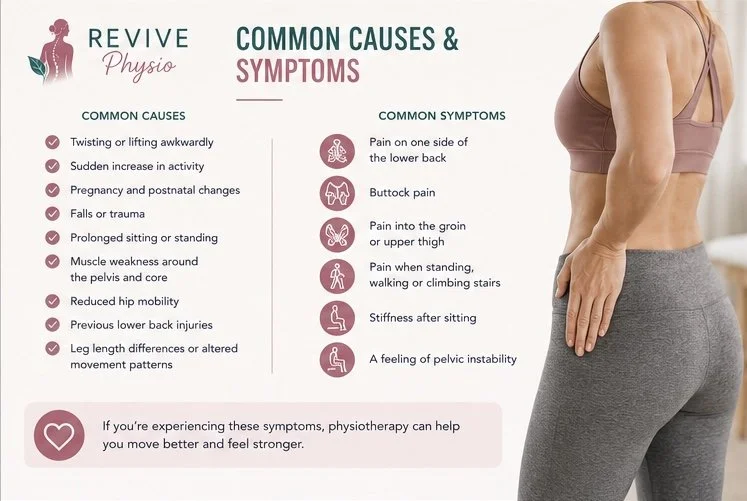
Common causes include:
Twisting or lifting awkwardly
Sudden increases in exercise or sporting activity
Pregnancy and postnatal changes
Falls or direct trauma
Prolonged sitting or standing
Muscle weakness around the pelvis and core
Reduced hip mobility
Previous lower back injuries
Leg length differences or altered walking patterns
Many people also develop symptoms gradually as poor movement patterns place repeated strain through the pelvis over time.
What does sacroiliac joint pain feel like?
SI joint pain can often mimic other conditions, which is why a thorough assessment is so important.
Symptoms may include:
Pain on one side of the lower back
Pain over the "dimples" at the bottom of your back
Buttock pain
Pain that can spread into the groin or upper thigh
Difficulty turning in bed
Pain when standing from sitting
Pain walking or climbing stairs
Pain on running
Pain when standing on one leg
A feeling that the pelvis is "out of place" or unstable
Stiffness after sitting for long periods
Unlike sciatica, SI joint pain usually doesn't travel all the way down the leg into the foot, although some people can experience referred pain into the thigh and calf.
Why does it keep coming back?
Many people experience temporary relief with massage, rest or pain medication, only for the pain to return weeks later.
This is because the underlying reason the joint became irritated hasn't been addressed.
Often this involves:
Poor pelvic control
Weak deep core muscles
Reduced glute strength
Altered movement patterns
Limited hip mobility
Persistent muscle imbalance
Unless these issues are corrected, the joint can continue to become overloaded.
How can physiotherapy help?
At Revive Physio, treatment doesn't simply focus on reducing pain—we aim to identify why your SI joint has become painful and correct the underlying cause.
Following a detailed assessment, your treatment plan will be tailored specifically to you.
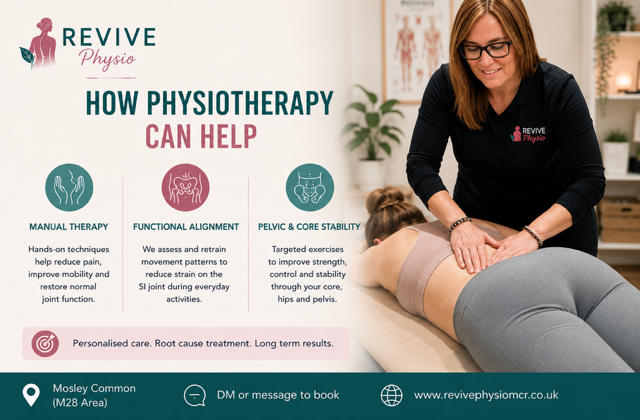
Manual therapy
Hands-on treatment can be highly effective at restoring normal movement and reducing pain.
Depending on your assessment, this may include:
Gentle sacroiliac joint mobilisation
Lumbar spine mobilisation
Hip joint mobilisation
Soft tissue massage
Myofascial release
Muscle energy techniques where appropriate
These techniques can help reduce muscle spasm, improve movement and allow the body to move more efficiently.
Functional alignment
One of the most important aspects of treatment is restoring normal movement through the pelvis.
Rather than simply trying to "put the pelvis back into place," we assess how your body moves during everyday activities such as:
Walking
Sitting to standing
Climbing stairs
Bending
Squatting
Single-leg balance
Small changes in movement can make a significant difference to the forces passing through the SI joints.
By improving functional alignment, we reduce unnecessary stress on the pelvis and lower back.
Pelvic and core stability
Research consistently shows that improving the strength and control of the muscles supporting the pelvis is key to achieving long-term recovery.
Your rehabilitation programme may include exercises to improve:
Deep abdominal control
Pelvic floor activation
Glute strength
Hip stability
Core endurance
Balance and coordination
Exercises are progressed gradually so you build confidence while returning safely to normal daily activities, work and sport.
Will I need scans?
In most cases, scans such as X-rays or MRI scans are not required.
A detailed physiotherapy assessment can usually identify whether your symptoms are likely to be coming from the sacroiliac joint while also ruling out other possible causes of pain.
If your assessment suggests further investigation is needed, we'll advise you accordingly and liaise with your GP if appropriate.
When should you seek physiotherapy?
The earlier SI joint dysfunction is treated, the easier it is to prevent ongoing pain and compensation.
You should consider booking an assessment if you:
Have persistent pain around the pelvis or lower back
Keep experiencing recurrent episodes
Struggle walking, bending or standing
Feel unstable through your pelvis
Have pain during pregnancy or after childbirth
Have tried resting but the pain keeps returning
Early assessment can help prevent symptoms becoming chronic and reduce the risk of developing secondary problems elsewhere in the back or hips.
How Revive Physio can help
At Revive Physio, we take time to understand the whole picture rather than simply treating the painful area.
Your assessment includes a detailed examination of your posture, movement patterns, joint mobility, muscle strength and functional control to identify the root cause of your symptoms.
Treatment may include:
Comprehensive physiotherapy assessment
Hands-on manual therapy
Functional movement retraining
Pelvic and core stability rehabilitation
Individual exercise programme
Education and self-management strategies
Advice on returning safely to work, exercise and everyday activities
Our aim isn't simply to relieve today's pain—it's to help prevent it from returning.
If you're experiencing lower back, buttock or pelvic pain, physiotherapy may help you move more comfortably, regain confidence and get back to doing the things you enjoy.
Revive Physio – Specialist Women's Physiotherapy & Wellbeing Clinic provides expert physiotherapy in Mosley Common, conveniently located for Worsley, Walkden, Boothstown, Tyldesley, Astley, Atherton and the surrounding Greater Manchester area. If you're struggling with sacroiliac joint pain, we'd be happy to help you get back to moving with confidence.