
Anterior Knee Pain: Why Does the Front of My Knee Hurt?

Pain at the front of the knee is incredibly common. It can affect runners and sportspeople, but you certainly don't need to be particularly active to develop it.
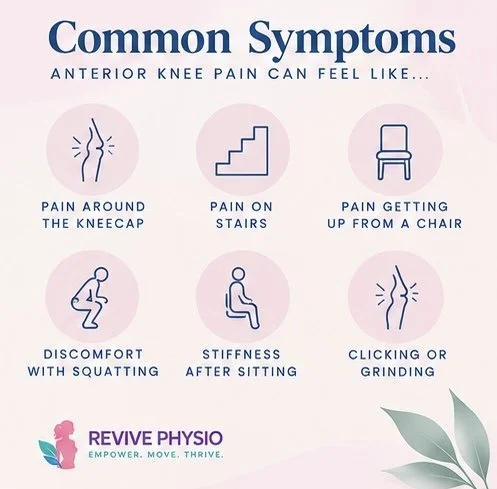
You might notice it walking downstairs, getting up from a chair, squatting, kneeling or after sitting for a long time.
But anterior knee pain isn't actually a diagnosis.
It simply describes where you're experiencing your pain , and there are several different structures and conditions that can produce very similar symptoms.
That's why understanding what is causing the pain is so important before deciding how to treat it.
What does anterior knee pain feel like?
Symptoms vary depending on the underlying problem, but you might experience:
An ache around or behind the kneecap
Pain underneath the kneecap
Pain at the bottom of the kneecap or into the patellar tendon
Pain when climbing or descending stairs
Pain with squatting, lunging or running
Discomfort after sitting with the knee bent for a long time
Stiffness when first getting moving
Clicking or grinding around the kneecap
Swelling in some conditions
Reduced confidence loading the affected leg
Where you feel the pain, when it occurs and what aggravates it all give your physiotherapist useful clues about what may be causing it.
What causes pain at the front of the knee?
One of the most common causes is patellofemoral pain, where pain is experienced around or behind the kneecap.
The kneecap — or patella — sits within the quadriceps tendon and moves within a groove at the end of the thigh bone as we bend and straighten the knee.
How the patellofemoral joint tolerates load can be influenced by several factors, including muscle strength, training load and movement patterns.
But that's not the only possibility.
Other causes of anterior knee pain can include patellar tendinopathy, osteoarthritis affecting the patellofemoral joint, fat-pad irritation, bursitis, trauma and other knee conditions.
Occasionally pain experienced around the knee may even be referred from elsewhere.
This is why Googling “exercises for knee pain” doesn't always solve the problem.
Different diagnoses need different treatment.
What about the quadriceps and VMO?
Your quadriceps muscles are extremely important for knee function.
They help straighten the knee, absorb load and control movements such as walking downstairs, squatting, running and getting up from a chair.
The vastus medialis — including the fibres often referred to as VMO — forms part of the quadriceps group.
You may have heard that anterior knee pain is caused by a “weak VMO” or that the VMO needs to be isolated to correct the position of the kneecap.
In reality, knee function is more complicated than one small part of one muscle.
Rather than trying to isolate the VMO, rehabilitation will usually involve progressively strengthening the quadriceps as a whole, while also considering hip and lower-limb strength and the specific activities you need your knee to tolerate.
Can tight muscles contribute?
They certainly can be part of the picture.
During an assessment I may look at the flexibility and mobility of structures including the:
Quadriceps • hamstrings • calf • hip flexors • lateral thigh structures
But feeling “tight” doesn't automatically mean that everything needs stretching.
Sometimes that sensation develops because a muscle is overloaded, weak or working harder than it should.
That's why treatment should be based on what we actually find during your assessment rather than simply stretching every tight area.
How can physiotherapy help?
Treatment depends entirely on the diagnosis.
At Revive Physio Mosley Common, Worsley, your assessment may include looking at knee movement, strength, functional movements such as squatting or stepping, hip and ankle function, muscle flexibility and the activities that aggravate your symptoms.
Treatment can then be tailored specifically to you.
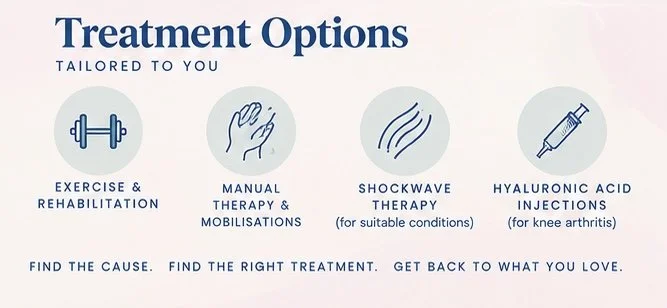
Strengthening and rehabilitation
For many people with anterior knee pain, progressive strengthening is one of the most important parts of treatment.
This might include quadriceps strengthening alongside hip, gluteal and calf work and gradually building your tolerance to activities such as stairs, squatting, running or sport.
And if osteoarthritis is contributing to the symptoms, exercise remains a core part of management; NICE recommends therapeutic exercise tailored to the individual, including local strengthening and general aerobic fitness.
Manual therapy and mobilisation
Depending on what I find during assessment, treatment may also include hands-on techniques.
This might involve mobilisation of the knee or patellofemoral joint where clinically appropriate, alongside treatment of relevant surrounding soft tissues.
These techniques can sometimes help improve movement or symptoms, but I generally use them alongside rehabilitation rather than instead of it.
The aim isn't simply to make the knee feel better on the treatment table.
It's to help it cope better with life outside the clinic.
Shockwave therapy
Shockwave isn't appropriate for every type of anterior knee pain.
However, if assessment suggests that the patellar tendon is the primary problem and symptoms have become persistent, shockwave therapy may sometimes be considered as an adjunct to an appropriate tendon-loading programme.
Shockwave uses acoustic pressure waves delivered to the target tissue. NICE describes ESWT as a non-invasive treatment, although mechanisms and evidence vary between different tendinopathies.
The important distinction is:
Shockwave isn't a treatment simply because your knee hurts at the front.
First we need to establish why it hurts.
Hyaluronic acid injections for knee arthritis
If assessment suggests your anterior knee pain is associated with knee or patellofemoral osteoarthritis, injection options may also form part of a wider discussion.
Hyaluronic acid is injected into the joint and is sometimes offered privately with the aim of reducing symptoms and improving function in people with osteoarthritis.
However, it's important to discuss the evidence and alternatives: current NICE guidance does not recommend routinely offering intra-articular hyaluronan injections for osteoarthritis, while recommending exercise and weight management where appropriate as core treatments.
At Revive, an injection would therefore never replace rehabilitation or strengthening. The first step is an appropriate assessment and a discussion about the potential benefits, limitations and alternatives for your particular knee.
When should I get knee pain assessed?
If your knee pain has persisted for several weeks, keeps returning or is beginning to stop you doing the things you enjoy, it's worth having it assessed.
You should also seek assessment if you're experiencing significant swelling, locking, giving way, inability to weight-bear, symptoms following significant trauma or symptoms that are worsening rather than improving.
You don't need to wait until the pain becomes unbearable.
The important thing? Find the cause first.
Two people can both point to exactly the same place at the front of their knee and have two completely different problems.
One might need progressive quadriceps and hip strengthening.
Another may have patellar tendinopathy requiring a carefully progressed tendon-loading programme.
Another may have symptoms associated with osteoarthritis.
That's why at Revive Physio I don't just treat where it hurts.
I want to understand why it hurts, what your knee is struggling to tolerate and what we can do to help you get back to the things you want to do.

Revive Physio | Mosley Common, M28
Physiotherapy • Rehabilitation • Shockwave Therapy • Injection Therapy
💗 Empower. Move. Thrive.