Carpal Tunnel Syndrome: Is Menopause Part of the Picture?
Pins and needles in your hand? Waking at night with numb fingers? Finding yourself shaking your hand to try to get the feeling back?
You may immediately think carpal tunnel syndrome — and sometimes that is exactly what is going on.
But symptoms such as tingling, numbness, aching or weakness in the hand don't always originate at the wrist. The median nerve begins much higher up, and problems affecting the neck, shoulder region or nerve pathway through the arm can sometimes produce very similar symptoms.
And for women in their 40s and 50s, there may be another piece of the puzzle worth considering: perimenopause and menopause.
What is carpal tunnel syndrome?
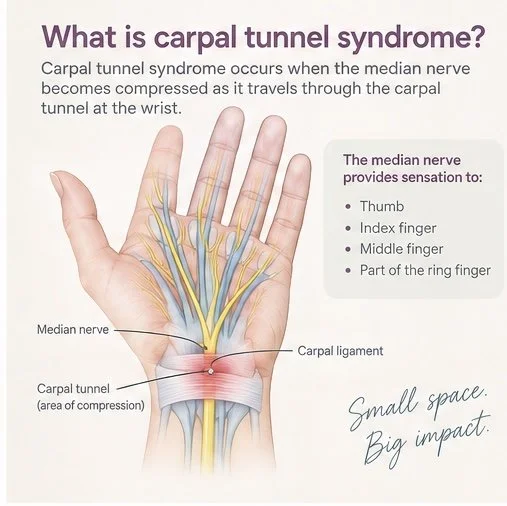
Carpal tunnel syndrome (CTS) occurs when the median nerve becomes compressed as it travels through the carpal tunnel at the wrist.
The median nerve provides sensation to much of the thumb, index finger, middle finger and part of the ring finger, as well as supplying muscles involved in thumb function.
Typical symptoms can include:
Pins and needles or numbness in the thumb, index and middle fingers
Symptoms that are particularly troublesome at night
Waking and needing to shake or move the hand
Aching or discomfort around the wrist and hand
Reduced grip or hand dexterity
Dropping objects
Weakness of the thumb in more established cases
Symptoms can affect one or both hands and may initially come and go before becoming more persistent.
What causes carpal tunnel syndrome?
Sometimes there isn't one obvious cause.
Anything that increases pressure within the carpal tunnel can potentially compress or irritate the median nerve.
Recognised risk factors include:
Repetitive or forceful wrist and hand activities
Prolonged positions involving wrist flexion or extension
Use of vibrating tools
Previous wrist injury or fracture
Pregnancy
Diabetes
Thyroid disorders
Rheumatoid or inflammatory arthritis
Being overweight
Family or anatomical predisposition
And interestingly, hormonal changes may also have a role.
Is carpal tunnel syndrome more common around menopause?
There does appear to be a relationship.
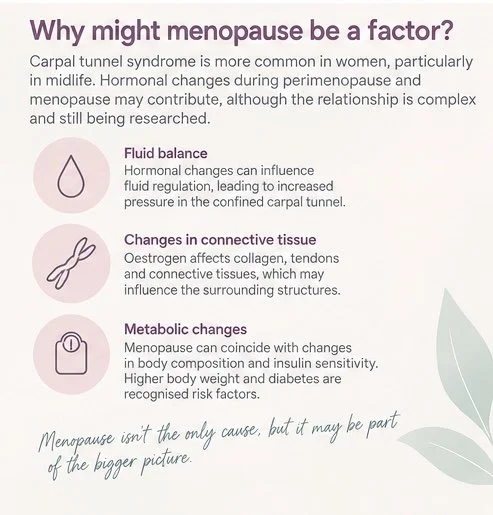
Carpal tunnel syndrome is considerably more common in women than men and is particularly common in women during midlife. Hormonal changes associated with menopause have therefore been investigated as a possible contributing factor.
The relationship isn't completely understood and we shouldn't assume that every woman developing hand symptoms during menopause has carpal tunnel syndrome.
However, there are several possible mechanisms.
Hormonal changes and fluid balance
Changes in oestrogen and other hormones can influence fluid regulation and tissues throughout the body.
Even relatively small changes in swelling within the carpal tunnel matter because it is a confined space. Increased pressure can potentially affect the median nerve.
Changes in connective tissue
Oestrogen has effects on collagen, tendons and connective tissues. Changes during menopause may therefore influence the tissues surrounding the tendons and nerves.
Metabolic changes
Midlife can also coincide with changes in body composition, insulin sensitivity and weight. Diabetes and higher body weight are independently recognised risk factors for carpal tunnel syndrome.
Research has also investigated whether menopausal hormone therapy influences the development of CTS. Some studies have suggested a possible protective effect, while systematic reviews conclude that the overall evidence remains inconsistent.
So there is an interesting relationship between hormones, menopause and carpal tunnel syndrome, but it is more complicated than simply saying "low oestrogen causes carpal tunnel".
But is it actually carpal tunnel?
This is one of the most important questions I ask when assessing someone with hand numbness or tingling.
The place where you experience symptoms isn't necessarily where the problem originates.
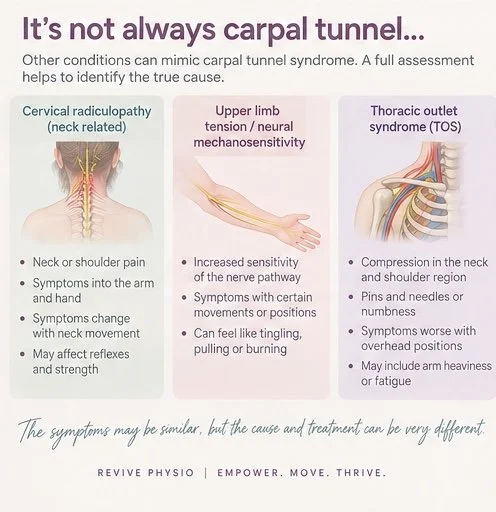
Several conditions can mimic carpal tunnel syndrome.
Could it be coming from your neck?
I regularly assess the neck when somebody presents with arm or hand symptoms.
Irritation or compression of a cervical nerve root — known as cervical radiculopathy — can produce pain, pins and needles, numbness or weakness extending down the arm and into the hand.
Clues might include:
Neck or shoulder-blade pain
Symptoms travelling further up the arm
Symptoms changing with neck movement or posture
Altered reflexes or muscle strength
A distribution of numbness that doesn't quite fit the median nerve
It is also possible for problems to exist at more than one level of the nerve pathway.
Neural sensitivity and upper limb tension
Sometimes a nerve isn't simply compressed at one particular point.
The nervous system needs to move and glide as we move our neck, shoulder, elbow, wrist and hand.
Increased neural mechanosensitivity, sometimes identified during an upper limb neurodynamic assessment, can reproduce symptoms such as tingling, pulling, burning or discomfort down the arm and into the hand.
This is why simply treating the wrist may not always address the whole problem.
Thoracic Outlet Syndrome
Thoracic outlet syndrome (TOS) is another potential differential diagnosis.
The nerves and blood vessels travelling into the arm pass through the thoracic outlet between the neck, first rib and shoulder region. Compression or irritation in this area can cause symptoms further down the arm.
Symptoms may include:
Pins and needles or numbness
Arm aching or heaviness
Symptoms aggravated by prolonged or overhead arm positions
Weakness or fatigue in the arm
In vascular forms, changes in colour, temperature or swelling
Again, this requires careful assessment because TOS, cervical nerve irritation and peripheral nerve compression can overlap in the way they present.
Why a full assessment matters
If somebody comes to me with suspected carpal tunnel syndrome, I don't just look at their wrist.
A physiotherapy assessment may include the:
Neck → shoulder → thoracic outlet → nerve pathway → elbow → forearm → wrist → hand
Depending on the presentation, I may assess sensation, strength, reflexes, grip, cervical movement, nerve mobility and specific tests around the wrist.
The aim is to answer an important question:
Where are your symptoms actually coming from?
Because treatment should be based on the cause rather than simply the location of the symptoms.
Revive Physio is conveniently located for people from Mosley Common, Worsley, Walkden, Boothstown, Tyldesley, Astley and Atherton.
How can carpal tunnel syndrome be treated?
Treatment depends on the severity and cause.
For mild or moderate symptoms this may include activity and ergonomic modification, avoiding prolonged aggravating wrist positions, a night wrist splint, exercises and addressing contributing problems elsewhere in the upper limb.
Mobilisations to the small bones in the wrist, nerve glides.
In some cases steroid injection may be considered, while persistent or severe median nerve compression, particularly where there is progressive weakness or muscle wasting, may require specialist assessment and potentially carpal tunnel decompression surgery.
Nerve conduction studies or imaging may also be appropriate when the diagnosis isn't clear.
Don't ignore persistent numbness or weakness
Occasional pins and needles after sleeping awkwardly is one thing.
Repeated night waking, persistent numbness, increasing weakness, loss of dexterity or repeatedly dropping things deserves assessment.
And if you're in perimenopause or menopause and have suddenly developed new aches, tingling or hand symptoms, don't automatically assume it's "just menopause".
Hormonal change may be one part of the picture, but there may also be a very treatable musculoskeletal or nerve problem contributing to your symptoms.
At Revive Physio, I look at the whole upper limb rather than simply treating the place that hurts — helping establish whether symptoms are coming from the wrist, nerve, neck or somewhere along the pathway.
Revive Physio is Specialist physiotherapy & wellbeing clinic based in Mosley Common, Worsley but covering surrounding areas Tyldesley, Astley, Atherton, Boothstown, Walkden, Greater Manchester
This article is for general information and does not replace individual medical assessment.