Plantar Fasciitis: Why Won’t My Heel Pain Go Away — and Could Shockwave Therapy Help?
Struggling with heel pain when you first get out of bed?
Do your first few steps in the morning hurt underneath your heel?
Does the pain ease once you get moving, only to return after you've been sitting down or when you've spent a long time walking or standing?
You may be experiencing plantar heel pain, commonly known as plantar fasciitis.
It's one of the most common foot problems I see as a physiotherapist — and it can be incredibly frustrating.
Some people struggle with it for months, continually resting, stretching or changing their shoes, only for the pain to return whenever they try to increase their activity.
The good news is that there are treatment options.
And for persistent plantar fasciitis that isn't responding as we'd expect to physiotherapy and rehabilitation, shockwave therapy may be one of the treatments we consider.
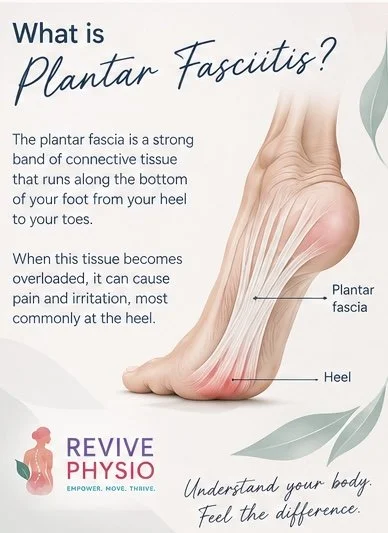
What is plantar fasciitis?
The plantar fascia is a strong band of connective tissue that runs along the bottom of your foot from your heel towards your toes.
It helps support the arch of your foot and plays an important role in absorbing and transferring load when you stand, walk and run.
When this tissue becomes overloaded, changes can occur within the plantar fascia and pain can develop, most commonly around its attachment at the heel.
Despite the name plantar fasciitis, persistent cases aren't necessarily simply an inflammatory problem. NICE describes chronic plantar fasciitis as involving degeneration of the plantar fascia and notes associations with microtears, inflammation or fibrosis.
What Does Plantar Fasciitis Feel Like?
There are some symptoms I hear again and again in clinic.
👣 Pain with your first steps in the morning
This is probably the symptom most people recognise.
You get out of bed, put your foot on the floor and those first few steps can be extremely painful.
After you've walked around for a little while, it may begin to ease.
👣 Pain after sitting
You may notice something similar when you've been sitting for a while.
You stand up and the heel is painful again for the first few steps.
👣 Pain underneath or towards the inside of the heel
The pain is usually concentrated around the underside of the heel, often towards the inside where the plantar fascia attaches.
👣 Pain with prolonged walking or standing
Although the pain may initially ease once you get moving, longer periods on your feet can cause it to increase again.
👣 Pain when activity increases
Running, long walks, holidays involving lots of sightseeing or suddenly increasing your exercise can all aggravate symptoms.
Why Have I Developed Plantar Fasciitis?
There usually isn't one single reason.
When I assess someone with plantar heel pain, I'm interested in much more than simply where it hurts.
Things that may contribute include:
A sudden increase in walking or running
Changes in exercise or training
Reduced calf strength or flexibility
Foot and ankle mechanics
Changes in footwear
Spending long periods standing
Reduced capacity of the plantar fascia to tolerate load
Previous foot or ankle problems
And sometimes there isn't an obvious trigger at all.
This is why simply downloading a few plantar fasciitis stretches from the internet doesn't necessarily solve the problem.
We need to understand why your plantar fascia is struggling with the load being placed upon it.
Why Can Heel and Tendon Pain Become More Noticeable During Perimenopause and Menopause?
Something I hear surprisingly often from women in their 40s and 50s is:
“I've never had problems with my feet before — why has this suddenly started now?”
There isn't always one simple answer, but perimenopause and menopause may be part of the bigger picture.
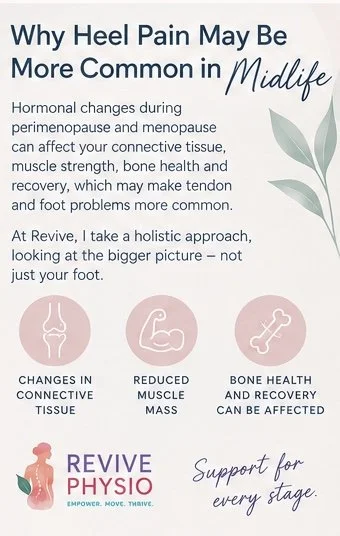
Oestrogen doesn't only have a role in periods and hot flushes. Oestrogen receptors are found throughout the musculoskeletal system, and hormonal changes during perimenopause and menopause can influence muscle, bone, joints and connective tissues, including tendons and fascia.
At the same time, women may experience changes in muscle mass and strength, sleep, recovery, body composition and activity levels. All of these factors can potentially influence how well our tissues cope with the loads we place upon them.
That doesn't mean menopause causes plantar fasciitis, and I wouldn't assume that every woman with heel pain has developed it because of hormonal changes.
But if you're a woman in your 40s, 50s or beyond who suddenly seems to be experiencing more heel pain, tendon problems, stiffness or recurring injuries, I think it's important that we consider the wider picture rather than simply treating the painful area.
Why this matters at Revive physio
This is one of the reasons I take a slightly different approach at Revive Physio.
As both a physiotherapist with over 22 years' experience and a menopause practitioner, I understand that the musculoskeletal changes women experience during midlife don't always happen in isolation.
If I assess a perimenopausal or menopausal woman with persistent plantar heel pain, I'm not just interested in her foot.
I'll consider things such as:
Her strength and current activity levels
Changes in exercise or training
Calf and foot capacity
Sleep and recovery
Other new joint or tendon symptoms
Changes that may have occurred during perimenopause or menopause
And, most importantly, what she wants to get back to doing.
It's about treating the person, not simply treating the heel
Why Doesn't Rest Fix Plantar Fasciitis?
This is something I explain to patients regularly.
If walking or running hurts, it's completely understandable to think:
“I'll just rest it until it gets better.”
And reducing an aggravating activity can certainly help settle an irritable flare.
But prolonged rest doesn't necessarily improve the capacity of the tissues to tolerate load.
You rest.
It feels better.
You start walking or exercising again.
And the pain returns.
That's why rehabilitation usually involves finding an appropriate level of activity while progressively improving the strength and load tolerance of the foot, ankle and calf.
Conservative treatment options recognised by NICE include physiotherapy, exercise/stretching, orthotic devices and other symptom-management approaches.
So Where Does Shockwave Therapy Fit In?
This is where things become particularly interesting for people with persistent plantar fasciitis.
If your heel pain has been there for months, keeps returning or hasn't improved as you'd hoped with appropriate rehabilitation, shockwave therapy may be another treatment option to consider.
Shockwave therapy uses acoustic pressure waves delivered through the skin into the tissues we're treating. It's a non-invasive treatment that may help reduce pain and stimulate biological processes involved in tissue repair and recovery.
For women going through perimenopause and menopause, I still think it's important that we look at the bigger picture. Shockwave doesn't address all the factors that may be contributing to your symptoms — and it doesn't replace strengthening and rehabilitation.
Instead, I use shockwave alongside physiotherapy, while also addressing things such as strength, mobility, activity levels, load management and the wider musculoskeletal changes that may be relevant during midlife.
The aim isn't simply to treat a painful heel — it's to help you get back to walking, exercising and doing the things you enjoy.
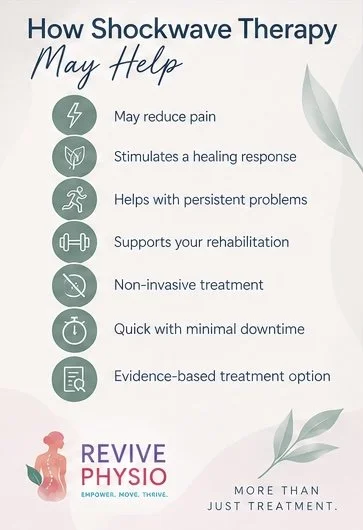
How May Shockwave Help Plantar Fasciitis?.
1. It May Help Reduce Pain
Pain reduction is one of the main outcomes we're looking for with shockwave.
For someone who has reached the point where every walk or period of standing aggravates their heel, reducing pain can make a significant difference to everyday function.
It can also make progressing your rehabilitation easier.
2. It Provides a Mechanical Stimulus to the Tissue
The acoustic waves generated by the machine provide a mechanical stimulus to the treatment area.
Research suggests shockwave can trigger biological responses within musculoskeletal tissues, although exactly how this translates into clinical benefit is complex and isn't completely understood. NICE specifically notes that the precise mechanism is uncertain.
That's why I prefer to describe shockwave as supporting or stimulating a healing response, rather than promising that it will “heal” the plantar fascia.
3. It Gives Us Another Option for Persistent Heel Pain
Most cases of plantar heel pain are initially treated conservatively.
But what happens when you've done the exercises, modified your activity and given it time — and you're still struggling months later?
That's when we may consider adding other treatments.
NICE specifically discusses shockwave in relation to refractory plantar fasciitis — in other words, plantar fasciitis that hasn't responded adequately to conventional treatment.
4. It's Non-Invasive
There are:
No needles
No injections
No incisions
No surgery
A treatment head is placed against the skin and the shockwaves are delivered into the treatment area.
You can definitely feel it, particularly over a sensitive heel, but I adjust the intensity according to your tolerance.
5. There's Usually Very Little Downtime
Shockwave itself only takes a few minutes.
You may experience some temporary soreness or tenderness afterwards, but most people can continue with their normal everyday activities, with appropriate advice about managing load and exercise.
This makes it a practical treatment option for people who don't want lengthy disruption to work or everyday life.
Does Shockwave Therapy Work for Plantar Fasciitis?
There is clinical research showing improvements in pain for some patients with persistent plantar fasciitis. For example, trials reviewed by NICE reported better pain-related outcomes for ESWT than sham treatment in some studies. However, NICE also concluded that the overall evidence on efficacy was inconsistent, partly because studies have used different devices, energies, protocols and outcome measures.
I think this is important to be transparent about.
Shockwave isn't a guaranteed cure.
It's a treatment option that may be useful for appropriately selected patients, particularly as part of a wider rehabilitation programme.
How Many Shockwave Sessions Will I Need?
There's no single treatment programme that's right for everybody.
At Revive, I generally work within a course of approximately 3–6 treatments, depending on your presentation, how long you've had the problem and how you're responding.
Treatment is usually combined with an individual rehabilitation programme rather than relying on shockwave alone.
And improvement doesn't necessarily happen immediately after treatment.
With a persistent problem, we're trying to create changes in pain, tissue capacity, strength and function over time.
What Else Will We Treat?
This is really important.
I don't just shockwave your heel and send you home.
With plantar fasciitis, I'll also consider what's happening through the rest of the kinetic chain, particularly the foot, ankle and calf.
Your treatment may therefore include:
✔️ Shockwave to the symptomatic plantar fascia/heel where appropriate
✔️ Assessment and treatment of the calf and surrounding tissues
✔️ Calf and foot strengthening
✔️ Mobility work where indicated
✔️ Advice about footwear
✔️ Activity and load modification
✔️ A progressive return to walking, running or sport
The aim isn't simply to make your heel feel better for a few days.
It's to help you build back towards the things your foot needs to tolerate.
Do I Need Shockwave — or Do I Need Physiotherapy?
If you're not sure whether you actually have plantar fasciitis, start with an assessment.
Heel pain isn't always plantar fasciitis.
There are other potential causes of pain around the heel and foot, and the correct diagnosis needs to come before deciding on treatment.
At Revive, I'll assess you first and explain what I think is causing your symptoms.
If shockwave is appropriate, we can then discuss incorporating it into your treatment.
And if it isn't?
I won't recommend it simply because I have the machine.
That's an important part of how I work.
When Should I Get My Heel Pain Assessed?
Consider getting your heel pain assessed if:
It's been present for several weeks and isn't improving
Your first steps every morning are painful
It's stopping you walking or exercising
You've started changing how you walk because of it
It repeatedly improves and then returns
You've tried exercises or other treatment without success
You're simply not sure what's causing it
The earlier we understand what we're dealing with, the sooner we can put an appropriate plan in place.
Plantar Fasciitis & Shockwave Therapy at Revive Physio
I'm Michelle, a Chartered Physiotherapist with over 22 years' experience and founder of Revive Physio, a specialist women's physiotherapy and wellbeing clinic in Mosley Common, Worsley.
Shockwave therapy is one of the newest treatments I've introduced at Revive and I'm particularly excited about what it adds to the options I can offer people struggling with persistent tendon and plantar heel problems.
If you've been putting up with heel pain for months and wondering whether anything else can be done, I'd be happy to assess you and talk through your options.
💙 You don't have to keep putting up with pain.
Revive Physio | Mosley Common, Worsley