7 Reasons Why Shockwave Therapy might help your pain
Have you been struggling with a pain that just doesn’t seem to settle?
Perhaps you’ve rested it, tried exercises, had massage or physiotherapy, only for the pain to return as soon as you increase your activity again.
If that sounds familiar, shockwave therapy may be worth considering.
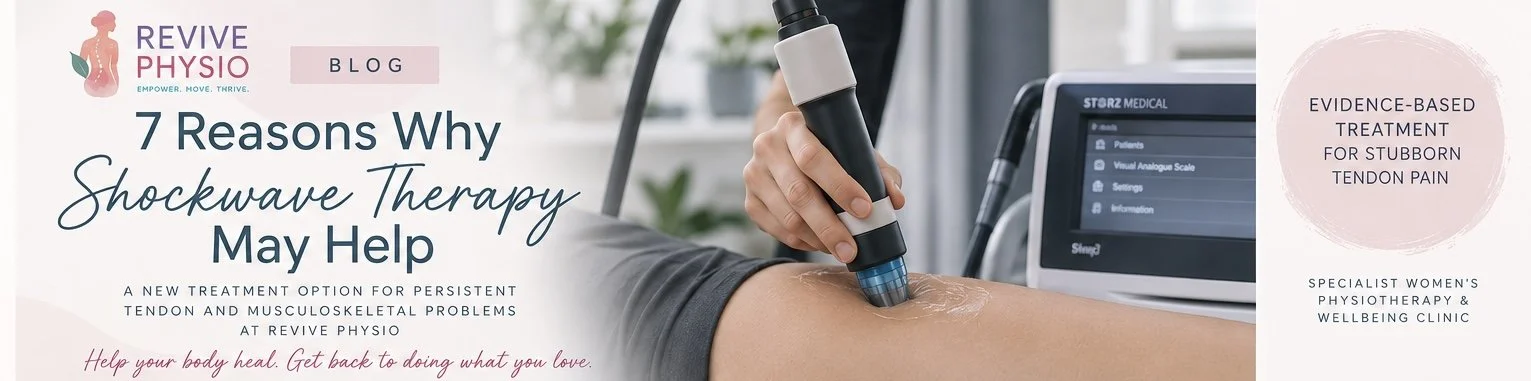
At Revive Physio, I’ve recently introducedshockwave therapy as an additional treatment option for persistent tendon and musculoskeletal conditions.
But what does shockwave actually do, and how could it help you?
Here are 7 reasons I may consider incorporating shockwave into your physiotherapy treatment.
1. Shockwave May Help Reduce Pain
One of the main reasons shockwave therapy is used is to help reduce pain associated with certain persistent musculoskeletal conditions.
Shockwave delivers acoustic pressure waves into the tissues being treated. These can influence pain signalling and stimulate biological responses within the area.
Reducing pain can be particularly helpful because it may allow you to move more comfortably and progress your rehabilitation.
The aim isn't simply to temporarily mask your symptoms. We still need to understand why the problem developed and what needs to change to achieve longer-term improvement.
2. It Stimulates a Biological Healing Response
Shockwave doesn't simply massage the painful area.
The acoustic waves provide a mechanical stimulus to the tissues, triggering biological processes associated with tissue remodelling and repair.
This is one of the reasons shockwave is particularly interesting for persistent tendon problems where the tissue may not be responding as expected to rehabilitation alone.
It essentially gives us another way of stimulating the area while we continue to work on strength, movement and load tolerance.
3. It Can Be Useful for Stubborn Tendon Problems
This is probably where shockwave really comes into its own.
Some tendon problems can persist for months despite rest, activity modification and rehabilitation.
Conditions where shockwave may be considered include:
Plantar heel pain / plantar fasciitis
Achilles tendinopathy
Patellar tendinopathy
Gluteal tendinopathy and Greater Trochanteric Pain Syndrome (GTPS)
Tennis elbow
Golfer's elbow
Some persistent soft-tissue conditions
It isn't appropriate for every painful tendon, however, which is why getting the diagnosis right comes first.
4. It May Help You Progress Your Rehabilitation
Shockwave isn't a replacement for exercise rehabilitation.
In fact, I generally see it as an addition to physiotherapy, rather than a standalone treatment.
If pain is preventing you from progressing your strengthening programme, reducing symptoms may make it easier to gradually increase the load your tendon can tolerate.
This is particularly important with tendinopathy.
Rest alone may temporarily settle symptoms, but if the tendon isn't gradually prepared for the demands of walking, running, sport or everyday activity, pain can return when those demands increase again.
Shockwave and a carefully progressed rehabilitation programme can therefore work alongside each other.
5. It's Non-Invasive
One of the advantages of shockwave therapy is that it is non-invasive.
There are:
No injections
No incisions
No anaesthetic
No surgery
A treatment head is placed against the skin over the area we're treating, and the shockwaves are delivered through it.
You will feel the treatment, and it can be uncomfortable over a sensitive area, but I can adjust the intensity according to your tolerance.
6. Treatment Is Quick With Minimal Downtime
The shockwave element of an appointment usually only takes a few minutes.
For most people, there is little disruption to normal daily life afterwards, although you may experience some temporary soreness or tenderness.
I'll advise you about activity following treatment and how to manage your rehabilitation between appointments.
A typical course often involves around 3–6 sessions, although the exact number will depend on your condition, how long you've had it and how you're responding.
It's also important to remember that improvement isn't always immediate. The biological response stimulated by shockwave and the adaptations created through rehabilitation can continue over time.
7. It's an Evidence-Based Treatment Option
Perhaps most importantly, shockwave isn't simply another new treatment trend.
Extracorporeal shockwave therapy has been researched for a number of musculoskeletal conditions, with evidence supporting its use for selected persistent tendon and related conditions.
However, shockwave isn't suitable for every condition or every patient.
And that's an important distinction.
I don't believe in using a treatment simply because I have the equipment available.
At Revive Physio, you will be assessed first so we understand what is causing your symptoms and whether shockwave is an appropriate option for you.
What Happens at a Shockwave Appointment at Revive Physio?
Your treatment starts with a physiotherapy assessment.
I'll talk to you about:
Where your pain is
How long you've had it
What aggravates and eases it
How it's affecting your everyday life
Treatments you've already tried
Your activity, exercise or sporting goals
I'll then assess the relevant joints, muscles and tendons to establish the most likely diagnosis.
If shockwave is appropriate, we'll discuss how it can be incorporated into your treatment plan.
Treatment may also include strengthening, mobility work, activity modification, load management and hands-on physiotherapy, depending on what you need.
Is Shockwave Therapy Right for Me?
Shockwave may be worth discussing if you've had a persistent tendon or musculoskeletal problem that:
✔️ Has been present for several weeks or months
✔️ Keeps returning when you increase your activity
✔️ Hasn't improved as expected with rehabilitation
✔️ Is preventing you from exercising or doing the things you enjoy
✔️ Has been properly assessed and diagnosed as a condition where shockwave may be appropriate
But the most important thing isn't deciding for yourself that you need shockwave.
It's finding out why you're in pain in the first place.
Once we have the right diagnosis, we can decide whether shockwave, physiotherapy and rehabilitation—or another treatment approach—is most appropriate for you.
Shockwave Therapy at Revive Physio
I'm Michelle, a Chartered Physiotherapist with over 22 years' experience and founder of Revive Physio, a specialist women's physiotherapy and wellbeing clinic in Mosley Common, Worsley.
I've introduced shockwave therapy because I wanted another evidence-based treatment option for some of the persistent tendon and musculoskeletal problems I regularly see in clinic.
It doesn't replace good physiotherapy.
It gives me another tool to use alongside it.
If you've been struggling with plantar heel pain, Achilles pain, tennis elbow, pain on the outside of your hip or another persistent tendon problem, a physiotherapy assessment can help establish what's causing it and whether shockwave could be appropriate for you.
💙 You don't have to keep putting up with pain.
Revive Physio | Mosley Common, Worsley