Why Does My Hip Hurt in Menopause? Gluteal Tendinopathy & Greater Trochanteric Pain Syndrome (GTPS)
Have you developed an aching or burning pain on the outside of your hip?
Perhaps it hurts when you lie on that side at night, walk for longer distances, climb stairs or get up from a chair.
Maybe you've been told you have trochanteric bursitis, but the pain keeps coming back.
If you're in your 40s, 50s or beyond, there may be another important piece of the puzzle.
Gluteal tendinopathy and Greater Trochanteric Pain Syndrome (GTPS) are particularly common in midlife and post-menopausal women.
At Revive Physio, a specialist women's physiotherapy and wellbeing clinic, we look beyond simply treating where it hurts. We assess why your hip has become painful and put together a treatment and rehabilitation programme designed to get you moving comfortably again.
What is Greater Trochanteric Pain Syndrome?
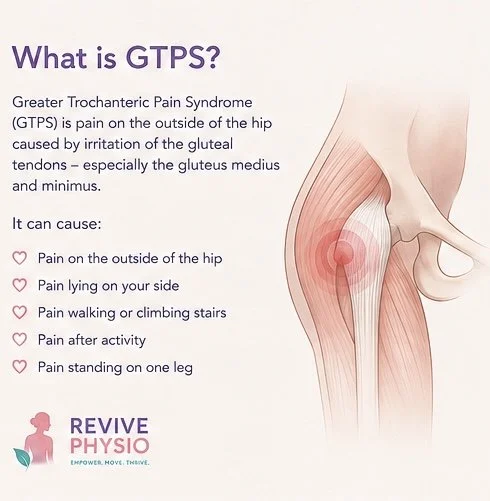
GTPS is the term used to describe pain arising from the structures around the outside of the hip.
Although it has traditionally been called trochanteric bursitis, we now know that the gluteal tendons — particularly the gluteus medius and gluteus minimus tendons — are frequently involved.
These tendons attach the gluteal muscles to the outside of the hip and play an important role in:
Stabilising your pelvis
Supporting you when walking and running
Climbing stairs
Standing on one leg
Controlling movement through your hip and pelvis
When these tendons become irritated or their capacity is exceeded by the load being placed upon them, gluteal tendinopathy can develop.
What does gluteal tendinopathy feel like?
Typical symptoms include:
Pain or aching over the outside of the hip
Pain when lying on the affected side
Hip pain disturbing your sleep
Pain when climbing stairs
Pain walking uphill
Pain after longer walks
Pain standing on one leg
Pain getting up from a low chair
Pain when running
Tenderness when you press the bony area on the outside of the hip
Pain when sitting with your legs crossed
Some people experience pain extending down the outside of the thigh.
Because hip, lumbar spine and referred pain can produce similar symptoms, having the area properly assessed is important.
Why is lateral hip pain so common around menopause?
GTPS is particularly prevalent in middle-aged and post-menopausal women. Research into GTPS has specifically investigated post-menopausal women because of this strong association.
One possible contributor is the change in oestrogen levels occurring through perimenopause and menopause.
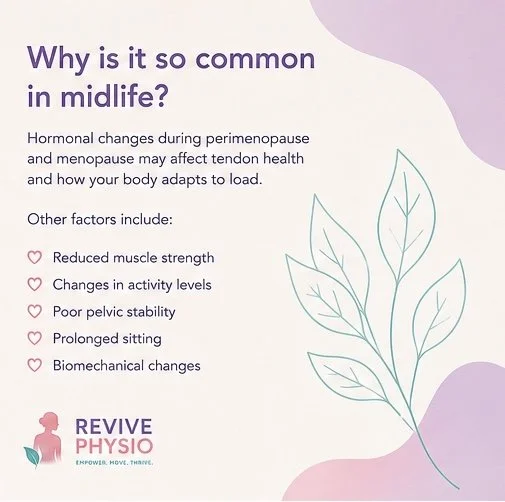
Oestrogen doesn't only affect our reproductive system. Receptors for oestrogen are found throughout musculoskeletal tissues, and hormonal changes may influence tendon health and the way tendons adapt to load.
This doesn't mean that menopause automatically causes gluteal tendinopathy.
Usually there are several contributing factors.
These might include:
Changes in activity levels
Suddenly increasing walking or running
Reduced muscle strength
Weakness around the hip and pelvis
Changes in body composition
Reduced tendon capacity
Poor pelvic control
Prolonged sitting
Repeated compression of the gluteal tendons
Changes in biomechanics
For some women, symptoms seem to appear without one obvious injury.
They simply notice that their hip has gradually started hurting.
That's why simply treating the painful spot isn't always enough.
Why does it hurt so much when I lie on my side?
This is one of the classic features of GTPS.
When you lie directly on the painful hip, the tissues around the greater trochanter are compressed.
But interestingly, sleeping on the opposite side can sometimes hurt too.
If the top leg drops across your body, the hip moves into adduction and can increase compression through the gluteal tendons.
A simple change can help:
Try sleeping with a pillow between your knees and thighs to keep your hips in a more neutral position.
We may also temporarily modify other positions that increase tendon compression while symptoms settle.
How do we treat gluteal tendinopathy/ GTPS?
There isn't one single treatment that fixes every painful hip.
Your treatment should be based upon your symptoms, strength, movement, activity levels and what we find during your physiotherapy assessment.
At Revive Physio, treatment may include a combination of:
Education and load management
One of the most important parts of treatment is understanding what is irritating your tendon.
That doesn't necessarily mean stopping everything.
Instead, we look at how much load your hip is currently tolerating and make sensible adjustments while gradually rebuilding its capacity.
Research supports education and exercise as a core approach to managing gluteal tendinopathy.
Manual therapy
Hands-on physiotherapy can be useful for addressing associated muscle tightness, stiffness and movement restrictions around the hip, pelvis and lower back.
Depending on your assessment, treatment may include:
Soft tissue techniques
Myofascial techniques
Joint mobilisation
Muscle release
Movement retraining
Manual therapy can help reduce symptoms and improve movement, but with tendinopathy we don't want to rely on hands-on treatment alone.
We also need to progressively strengthen the tendon and the muscles supporting it.
Stretching and mobility
Appropriate mobility exercises can be useful when there is genuine restriction or muscle tightness around the hip.
However, with gluteal tendinopathy, more stretching isn't always better.
Some aggressive hip stretches place the gluteal tendons into compression and can actually aggravate lateral hip pain.
Your physiotherapist can identify which areas need mobility work and which positions you may temporarily need to modify.
Strengthening
This is a really important part of rehabilitation.
Your programme may gradually work on:
Gluteus medius and minimus
Gluteus maximus
Hip abductors
Hip extensors
Core muscles
Pelvic stabilisers
Functional lower-limb strength
Exercises might progress from controlled low-load exercises to:
Bridges → sit-to-stands → resisted hip exercises → step-ups → single-leg control → squats and lunges → walking/running-specific loading.
The exact programme depends on you.
Research supports exercise as a first-line treatment for GTPS, particularly as part of a programme that includes education and load management.
Stability and movement control
Sometimes the painful tendon is only part of the picture.
If your pelvis drops excessively when you walk, climb stairs or stand on one leg, the gluteal muscles have to work differently to control you.
We can therefore assess:
Single-leg balance
Pelvic stability
Hip control
Walking pattern
Squatting
Step-down control
Running mechanics where appropriate
Your rehabilitation can then address the factors that are relevant to your hip rather than giving everyone the same generic set of exercises.
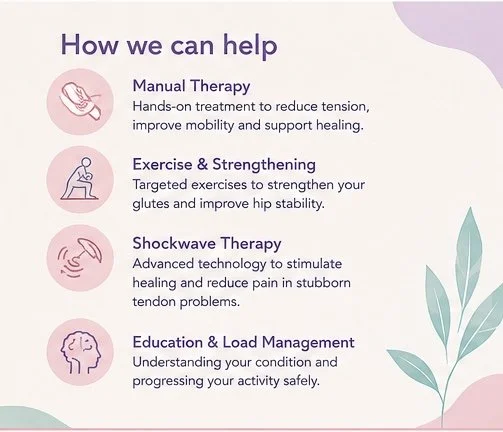
Shockwave Therapy
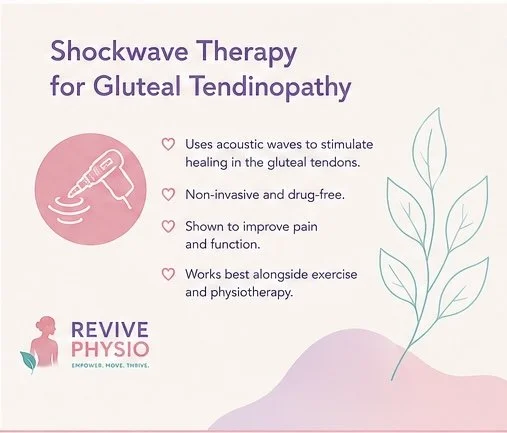
For persistent gluteal tendinopathy and GTPS, Extracorporeal Shockwave Therapy (ESWT) is another treatment option.
Shockwave uses acoustic pressure waves delivered into the affected tissues.
It is non-invasive and is commonly used for persistent tendon problems that haven't responded fully to more conventional treatment.
Research has shown promising results for shockwave therapy in GTPS and gluteal tendinopathy. Randomised trials have demonstrated improvements in pain and function, including when shockwave is combined with an exercise programme.
A 2025 systematic review concluded that exercise and education should remain at the heart of treatment, with focused shockwave therapy among the treatments that may be used alongside this approach.
At Revive Physio, shockwave isn't used as a replacement for rehabilitation.
Instead, where appropriate, we can combine:
Shockwave + physiotherapy + progressive strengthening + stability work + advice on tendon loading.
The aim isn't simply to temporarily reduce your pain.
It's to help the tendon tolerate the things you actually want to do again.
Don't just put up with hip pain because you're getting older
One of the things we hear frequently from women in midlife is:
"I just thought it was my age."
Pain in your 40s, 50s and beyond shouldn't simply be dismissed as ageing or menopause.
If your hip is stopping you sleeping, walking, exercising or doing the things you enjoy, there are things we can do about it.
Understanding what's causing your pain is the first step.
At Revive Physio – a specialist women's physiotherapy and wellbeing clinic, we take the time to assess your hip, strength, movement and lifestyle before creating an individual treatment plan.
Treatment may include physiotherapy, manual therapy, tailored exercise rehabilitation, strengthening, stability work and Shockwave Therapy where clinically appropriate.
Because the goal isn't simply to settle your hip pain.
It's to help you move better, feel stronger and get back to doing the things you love.
Revive Physio
Empower. Move. Thrive.