Persistent tendon or soft tissue Pain That Just Won't Settle? Shockwave Therapy Is Now Available at Revive Physio
Have you got an injury or painful area that just seems to keep coming back?
Maybe you've rested it.
You've tried stretching.
You've changed your shoes, stopped running or avoided the activities that aggravate it.
It improves for a while… and then as soon as you start doing more, the pain returns.
Persistent tendon and soft tissue problems can be incredibly frustrating – and sometimes they need a little more help to get moving in the right direction.
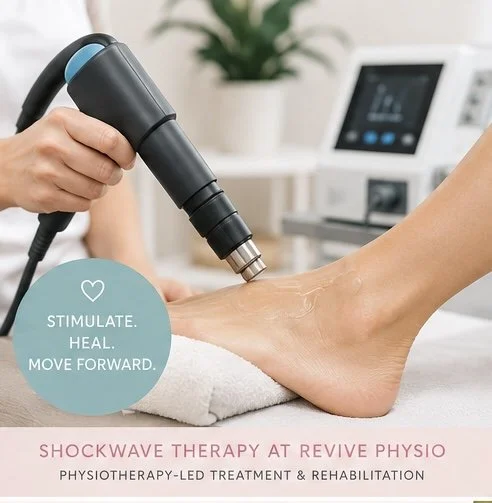
That's why I'm really pleased to now offer Radial Shockwave Therapy at Revive Physio.
What is Shockwave Therapy?
Shockwave Therapy is a non-invasive treatment that uses mechanical pressure waves delivered through the skin into the affected tissues.
It is commonly used within physiotherapy for persistent tendon and soft tissue conditions, particularly when symptoms haven't responded as expected to initial rehabilitation or other conservative treatments.
There are:
✓ No needles
✓ No injections
✓ No surgery
✓ Minimal downtime
And treatment can be incorporated directly into your physiotherapy and rehabilitation programme.
What can Shockwave Therapy help with?
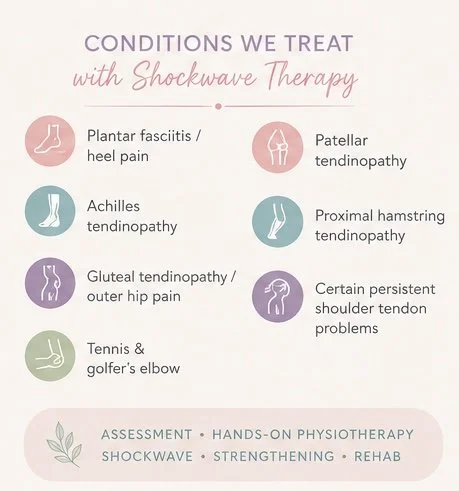
Shockwave may be considered for a number of persistent musculoskeletal conditions, including:
✓ Plantar fasciitis / persistent heel pain
✓ Achilles tendinopathy
✓ Gluteal tendinopathy / greater trochanteric pain
✓ Tennis elbow
✓ Golfer's elbow
✓ Patellar tendinopathy
✓ Proximal hamstring tendinopathy
✓ Certain persistent shoulder and rotator cuff tendon problems
Not every painful condition is suitable for shockwave, which is why assessment and an accurate diagnosis come first.
Why do some tendon problems take so long to settle?
One of the biggest misconceptions around persistent tendon pain is that the tendon simply needs more rest.
Actually, tendons need load.
The difficulty is getting the amount of load right.
Too much can repeatedly aggravate symptoms, while avoiding activity altogether can reduce the tendon and surrounding muscles' ability to tolerate load.
Persistent tendon pain can also be influenced by several factors, including strength, previous injury, activity levels, training changes, recovery, sleep and general health.
For women, there may be another piece of the puzzle.
Tendon pain in your 40s and 50s
Many women tell me that they've reached their 40s or 50s and suddenly seem to be experiencing aches, pains or injuries that they never had before.
This can coincide with perimenopause and menopause.
Changing hormone levels, including changes in oestrogen, may influence collagen and wider musculoskeletal health. At the same time, changes in muscle mass, strength, sleep, recovery and activity can all influence how our tissues tolerate load.
It doesn't mean menopause is automatically responsible for your painful heel, hip or shoulder.
But it does mean that treating women in midlife sometimes requires us to look beyond the painful body part.
As a specialist women's physiotherapy and wellbeing clinic, that's an important part of the approach we take at Revive Physio.
How could Shockwave help?
Shockwave provides a controlled mechanical stimulus to the affected tissues.
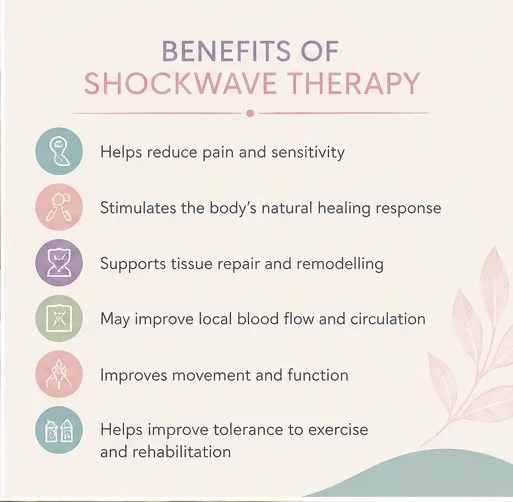
Research suggests it may help to:
✓ Reduce pain and sensitivity
✓ Stimulate biological processes associated with healing
✓ Support tissue repair and remodelling
✓ Improve local circulation
✓ Improve movement and function
✓ Help you progress strengthening and rehabilitation
However, shockwave isn't a magic wand – and I don't want it to be viewed as one.
For many persistent tendon problems, progressive strengthening and rehabilitation remain essential.
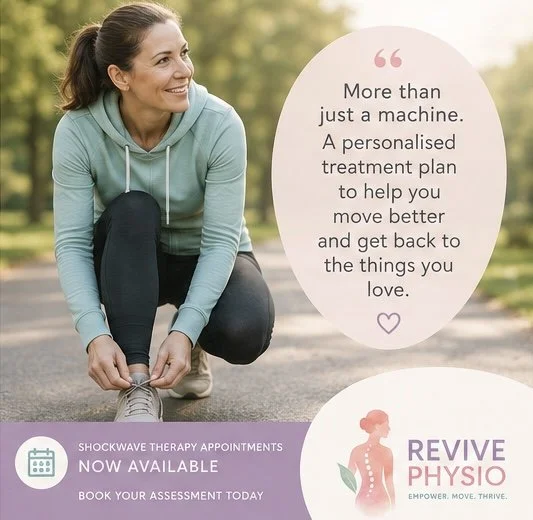
More than just a machine
Coming to Revive Physio for Shockwave Therapy isn't simply about having a machine placed on the painful area for a few minutes.
Treatment is physiotherapist-led.
We look at:
✓ What is actually causing your pain
✓ Why it may not be settling
✓ Your strength and movement
✓ How you're loading the area
✓ What activities you're trying to return to
✓ What rehabilitation you need alongside treatment
Shockwave can then be incorporated where clinically appropriate.
The aim isn't simply to make something hurt less for a few days.
It's to help you move better, become stronger and get back to doing the things you enjoy.
How many treatments will I need?
Shockwave is usually delivered as a course of treatments rather than a one-off session.
We will often start with around three sessions and review your response, with some conditions benefiting from further treatment. Research is based around 3-6 sessions for full benefits and we offer competitive packages to support the treatment as a course rather than just a one-off session.
Your treatment plan will depend upon your individual condition, how long you've had symptoms and how you're progressing.
Is Shockwave Therapy right for you?
It may be worth considering if you have a tendon or soft tissue problem that:
✓ Has been present for several weeks or months
✓ Keeps returning when you increase your activity
✓ Hasn't improved as expected
✓ Is stopping you exercising or playing sport
✓ Is interfering with walking, sleeping or everyday life
✓ Hasn't fully responded to previous treatment or rehabilitation
The first step is establishing what's actually going on.
Shockwave Therapy is now available at Revive Physio
I'm really excited to add Shockwave Therapy to the treatments available at Revive Physio – a specialist women's physiotherapy and wellbeing clinic in Mosley Common.
It gives me another treatment option for those stubborn, persistent tendon and soft tissue problems that I see so frequently in clinic.
And importantly, it complements what I already believe strongly in:
Good assessment. The right treatment. Progressive strengthening. And helping you understand your body so you can move forward with confidence.
Fed up with pain that keeps coming back?
Shockwave Therapy appointments are now available at Revive Physio.
Book an assessment to find out what's causing your symptoms and whether Shockwave Therapy could be appropriate for you.
Revive Physio
Specialist Women's Physiotherapy & Wellbeing Clinic
Mosley Common