Shockwave Therapy: Could It Help Your Persistent Tendon Pain?
Have you been struggling with heel, hip, Achilles, elbow or shoulder pain that just doesn't seem to settle?
Perhaps you've rested it, tried exercises or changed your activity, but every time you start doing more, the pain returns.
For persistent tendon and soft tissue problems, Shockwave Therapy may be another treatment option.
At Revive Physio – a specialist women's physiotherapy and wellbeing clinic, we offer Shockwave Therapy alongside physiotherapy, strengthening and rehabilitation to help people struggling with persistent musculoskeletal pain.
But what actually is shockwave therapy, how does it work and who might benefit?
What is Shockwave Therapy?
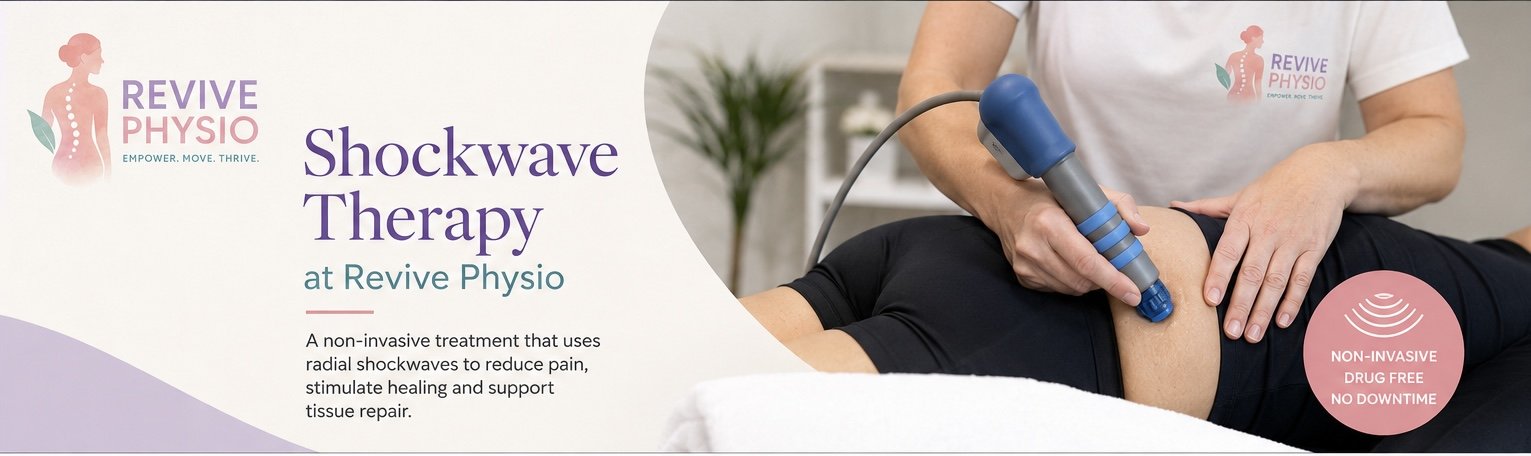
Shockwave Therapy is a non-invasive treatment that delivers mechanical pressure waves through the skin into the affected tissues.
Despite the name, there are no electrical shocks involved.
A handheld applicator is placed over the area being treated and delivers repeated pressure waves into the tissues.
Radial shockwave therapy is used within physiotherapy and musculoskeletal medicine, particularly for persistent tendon and soft tissue conditions.
The treatment doesn't involve needles or injections and usually requires very little downtime.
Why can tendon pain become persistent?
Tendon problems aren't always simply caused by inflammation.
Tendons are designed to tolerate load. Every time we walk, run, climb stairs, lift weights or exercise, our muscles and tendons have to cope with the forces placed through them.
Sometimes the demands placed on a tendon become greater than its current capacity to cope.
This might happen following:
A sudden increase in exercise
Repetitive activity
Returning to sport after a break
Reduced muscle strength
Previous injury
Changes in biomechanics
Poor recovery
Changes in general health
Over time, a painful tendon can also become increasingly sensitive, making activities that were previously comfortable much more difficult.
This is why simply resting a persistent tendon problem doesn't always solve it.
What does Shockwave actually do?
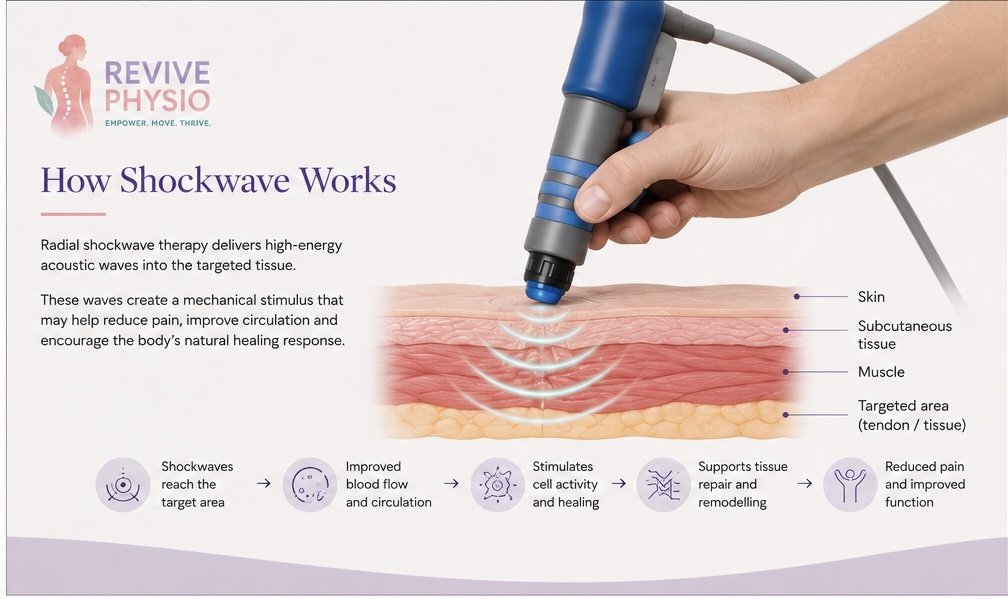
Shockwave delivers a controlled mechanical stimulus into the tissues.
Research suggests this may influence pain and biological processes associated with tissue repair and remodelling.
Potential effects include:
Reducing pain and sensitivity
Stimulating local circulation
Encouraging cellular activity associated with tissue repair
Supporting tissue remodelling
Helping improve tolerance to rehabilitation and exercise
The precise mechanisms behind shockwave therapy continue to be researched.
Importantly, shockwave isn't a magic wand.
For persistent tendon problems, it is usually most useful when combined with an appropriate strengthening and rehabilitation programme.
What problems can Shockwave Therapy be used for?
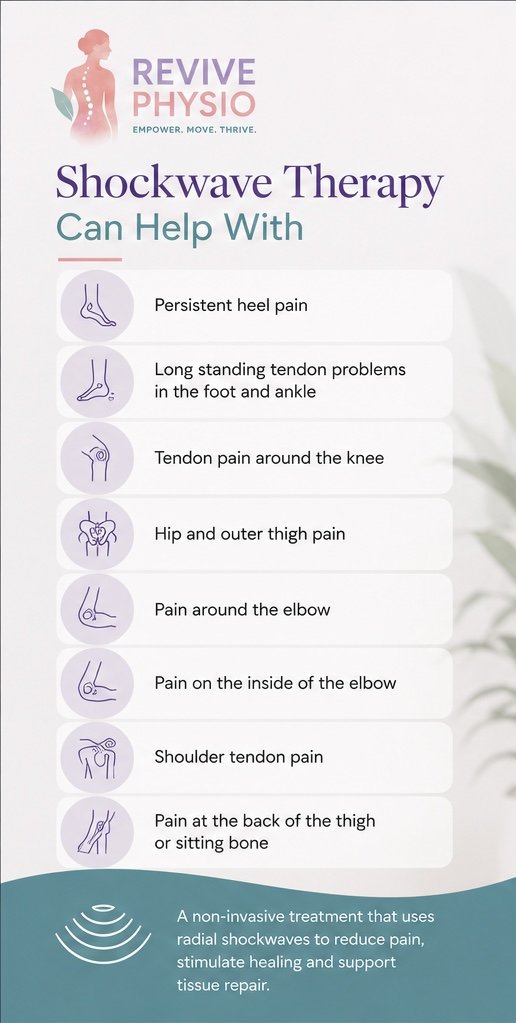
Shockwave is most commonly considered for persistent tendon and soft tissue conditions, particularly when symptoms haven't settled with initial conservative treatment.
These can include:
Plantar fasciitis / plantar heel pain
That familiar pain underneath the heel – often particularly uncomfortable when taking your first few steps in the morning or getting up after sitting.
Achilles tendinopathy
Pain and stiffness affecting the tendon at the back of the ankle, sometimes accompanied by thickening or tenderness.
Gluteal tendinopathy and outer hip pain
Pain around the outside of the hip, which can make walking, stairs and lying on your side uncomfortable.
Tennis and golfer's elbow
Persistent tendon pain around either the outside or inside of the elbow, often aggravated by gripping, lifting or repetitive activity.
Proximal hamstring tendinopathy
Pain around the sitting bone and upper hamstring that can be particularly troublesome with running or prolonged sitting.
Patellar tendinopathy
Pain affecting the tendon below the kneecap, often associated with running, jumping, squatting or sport.
Some persistent shoulder tendon problems
Shockwave may also be considered for certain rotator cuff tendon conditions, including calcific tendinopathy.
Whether shockwave is appropriate depends upon your individual diagnosis, which is why a physiotherapy assessment is important before starting treatment.
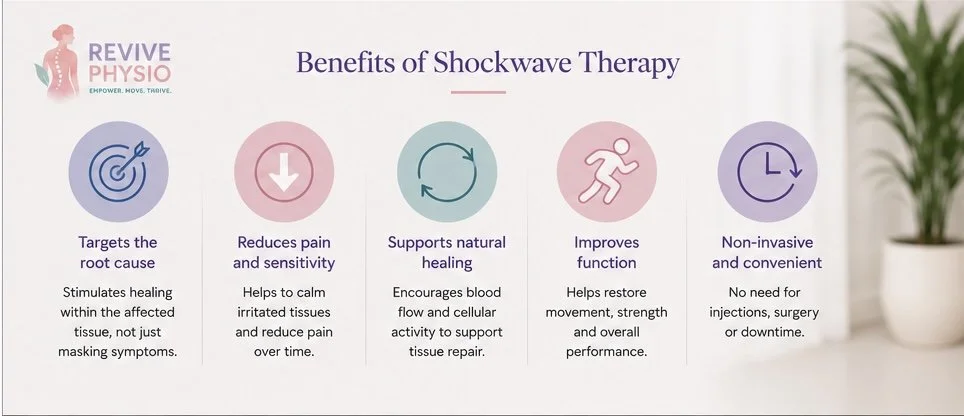
BENEFITS OF SHOCKWAVE
✓ Helps reduce pain and sensitivity
✓ Stimulates the body’s natural healing response
✓ Supports tissue repair and remodelling
✓ May improve local blood flow and circulation
✓ Improves movement and function
✓ Helps improve tolerance to exercise and rehabilitation
✓ Useful for persistent tendon and soft tissue problems
✓ Non-invasive – no needles or surgery
✓ Drug-free treatment option
✓ Minimal downtime
✓ Quick treatment sessions
✓ Works alongside physiotherapy and progressive strengthening
Why are tendon problems particularly relevant to women in midlife?
One thing I hear regularly from women in their 40s and 50s is:
“I don't understand why I'm suddenly getting all these aches and pains.”
Musculoskeletal symptoms are common during perimenopause and menopause, and changing hormone levels may be one piece of a much bigger picture.
Oestrogen has roles within musculoskeletal tissues, including collagen metabolism. Alongside hormonal changes, midlife can also coincide with changes in muscle mass, strength, sleep, recovery, activity levels and body composition.
All of these factors can potentially influence how muscles and tendons respond to load.
That doesn't mean every painful tendon in a woman over 40 is caused by menopause.
It does mean we need to look at the whole person rather than simply treating the painful body part.
At Revive Physio, this is particularly important to us.
As a specialist women's physiotherapy and wellbeing clinic, we consider the wider factors that may be contributing to your symptoms and help you build strength and resilience for the future.
What does Shockwave Therapy feel like?
A small amount of gel is applied to the skin before the shockwave applicator is placed over the treatment area.
You'll feel a repetitive tapping or pulsing sensation.
Treatment can feel uncomfortable over particularly sensitive areas, but the intensity can be adjusted according to your tolerance.
The actual shockwave component of the appointment usually only takes a few minutes.
At Revive Physio, however, your appointment isn't simply about using a machine.
Your symptoms, progress and rehabilitation are reviewed so that treatment continues to address the underlying problem.
How many sessions will I need?
This varies depending upon the condition, how long it has been present and how you respond.
Shockwave is commonly delivered as a course of treatments, often starting with around three sessions before reviewing progress and deciding whether further treatment is appropriate.
Some people may require a longer course.
Improvements can also continue after the treatment course has finished as the tissues adapt and rehabilitation progresses.
What does the research say?
Shockwave Therapy has been investigated for a number of musculoskeletal conditions.
Research has reported improvements in pain and function in some patients with persistent tendon and plantar fascia problems, although results vary between conditions and between studies.
Both focused and radial shockwave are used clinically. Radial shockwave delivers unfocused pressure waves through the tissues and is widely used within musculoskeletal physiotherapy.
It is important to be transparent that shockwave doesn't work for everyone and the quality of evidence differs between conditions.
This is another reason we don't treat shockwave as a stand-alone cure.
Instead, we use it when clinically appropriate as one component of an individual rehabilitation programme.
Is Shockwave Therapy safe?
Shockwave is non-invasive and generally well tolerated when used appropriately.
Temporary effects can include:
Redness
Tenderness
Aching
Mild swelling
Bruising
There are also circumstances where shockwave may not be appropriate.
Your medical history and medication should therefore be checked before beginning treatment.
In particular, let your physiotherapist know if you are pregnant, taking anticoagulant or blood-thinning medication, have a bleeding disorder, active infection, impaired sensation or another significant medical condition.
Could Shockwave Therapy help me?
Shockwave may be worth considering if you've been struggling with a tendon or soft tissue problem that:
Has been present for several weeks or months
Keeps returning
Isn't improving as expected
Is stopping you exercising
Is interfering with walking or everyday life
Hasn't fully responded to previous physiotherapy or rehabilitation
But the important question isn't simply:
“Can I have shockwave?”
It's:
“Why is this problem still hurting, and what does it need to recover?”
That's what we aim to establish first.
Shockwave Therapy at Revive Physio
At Revive Physio – a specialist women's physiotherapy and wellbeing clinic in Mosley Common, Manchester, Shockwave Therapy is provided as part of a physiotherapist-led treatment and rehabilitation programme.
We don't simply treat the painful spot.
We look at what's contributing to the problem, what may be preventing it from settling and what you need to help you get back to the things you enjoy.
Whether that's walking without heel pain, sleeping comfortably on your side, returning to running or simply feeling stronger and more confident in your body, treatment is tailored to you.
Struggling with persistent tendon pain?
Find out more about Shockwave Therapy at Revive Physio or book an assessment to see whether it could be appropriate for you.
Revive Physio
Specialist Women's Physiotherapy & Wellbeing Clinic
Mosley Common, Manchester
Helping women move better, feel stronger & thrive.