Strength Training During Menopause: Why Getting Stronger Matters More Than Ever
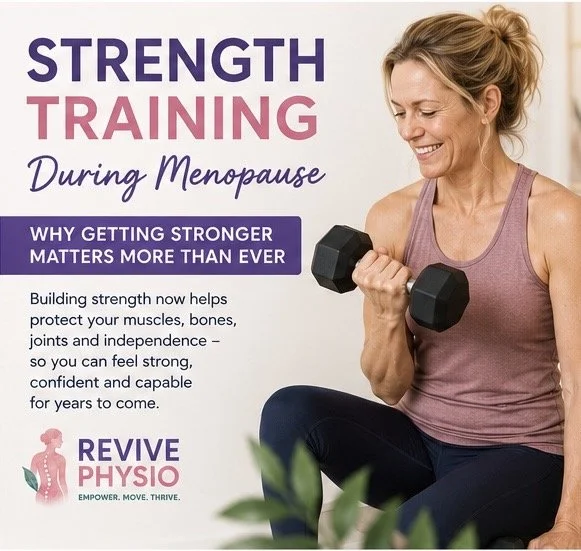
When we talk about exercise during menopause, the conversation often focuses on walking more, doing cardio or trying to lose weight.
But there's another type of exercise that becomes increasingly important as we move through our 40s, 50s and beyond:
Strength training.
And no—you don't need to become a bodybuilder or spend hours lifting enormous weights in the gym!
Strength training simply means asking your muscles to work against resistance.
That resistance could come from your own body weight, resistance bands, dumbbells, gym equipment or heavier weights.
As both a Chartered Physiotherapist and Menopause Practitioner, it's something I encourage women to think about not simply as exercise, but as an investment in their future health.
Because during perimenopause and menopause, maintaining our muscles, bones, joints and physical capacity becomes more important than ever.
What Happens to Muscle During Menopause?
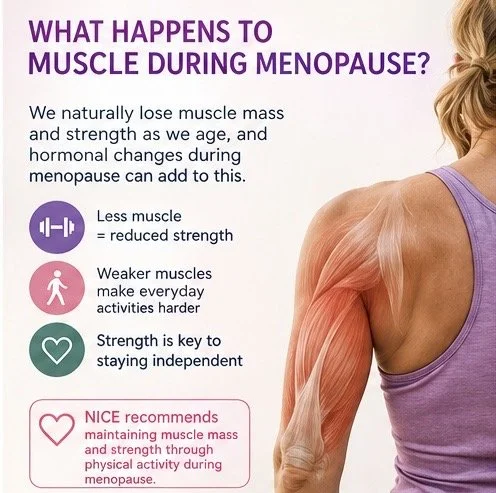
We naturally begin to lose muscle mass and strength as we get older.
The hormonal changes associated with menopause can add to changes in muscle mass, body composition and physical performance.
This matters because muscle does so much more than change how our bodies look.
We need muscle to:
Walk
Climb stairs
Lift and carry
Get up from the floor
Protect our joints
Maintain balance
Exercise
Remain independent as we get older
NICE specifically recommends explaining to people experiencing menopause the importance of maintaining muscle mass and strength through physical activity.
The aim isn't necessarily to look more muscular.
It's to remain strong and capable.
Why Is Strength Training So Important During Menopause?
1. It Helps Preserve Muscle
Our muscles respond to demand.
If we challenge them appropriately, they adapt and become stronger.
If we don't use them, we gradually lose strength.
Resistance training provides the stimulus our muscles need to maintain and build strength.
Research in postmenopausal women consistently shows improvements in upper- and lower-body strength following resistance training.
That means everyday life becomes easier—not just your gym session.
2. Strength Training Supports Your Bones
Menopause is also an important time for bone health.
Oestrogen plays an important role in maintaining bone density. As oestrogen levels decline around menopause, bone loss accelerates and the risk of osteoporosis and fragility fractures increases as we get older.
Bones, however, are living tissue.
Just like muscles, they respond to the forces we place through them.
When muscles contract during resistance exercise, they pull on our bones. Weight-bearing and appropriate impact exercise also place forces through the skeleton.
These mechanical loads stimulate bone and help maintain its strength.
This is why strength and weight-bearing/impact exercise are such an important combination for women during and after menopause.
3. Stronger Muscles Help Support Your Joints
If you've read my blog on Menopause and Joint Pain, you'll know that hormonal changes can influence our musculoskeletal system.
Strengthening the muscles around our joints helps improve their ability to manage load.
For example:
Strong quadriceps and gluteal muscles help support the knees.
Strong gluteal muscles help control the pelvis and hips.
Strong calf muscles help support the ankle and Achilles.
Strong shoulder and upper-back muscles help control the shoulder complex.
This can be particularly important for women experiencing osteoarthritis or recurrent musculoskeletal pain.
4. It Helps Tendons Become Stronger
Tendons also need load.
A tendon connects muscle to bone and adapts to the forces we regularly place through it.
During menopause, changes in oestrogen, collagen metabolism, muscle strength and recovery may contribute to the development of tendon problems in some women.
This is why avoiding activity altogether isn't usually the answer.
Appropriate progressive resistance training can help increase the capacity of muscles and tendons to tolerate load.
If you're already experiencing tendinopathy, however, the exercises and progression may need to be adapted.
“But I'm Walking Every Day – Isn't That Enough?”
Walking is fantastic.
I absolutely encourage it.
Walking benefits:
Cardiovascular health
Mental wellbeing
General activity levels
Bone loading
Weight management
Mobility
But walking and strength training do different jobs.
Walking doesn't usually provide enough progressive resistance to maximise muscle strength.
So rather than choosing between them, ideally we want both:
Walk. Move. Lift. Strengthen.
What Actually Counts as Strength Training?
You don't necessarily need a gym.
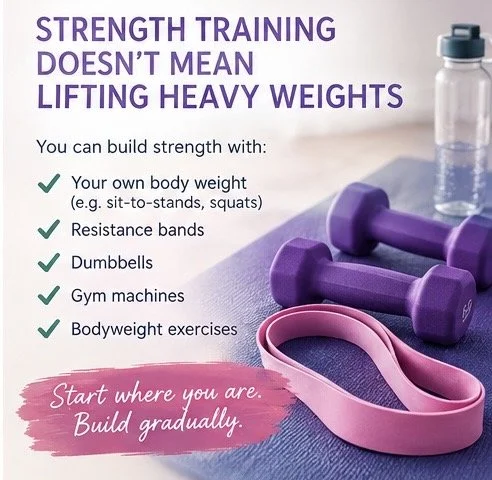
Resistance can come from:
Your own body weight
Resistance bands
Dumbbells
Kettlebells
Barbells
Gym machines
Weighted household objects
Exercises might include:
Squats
Sit-to-stands
Lunges
Step-ups
Bridges
Deadlift or hip-hinge movements
Calf raises
Rows
Chest or wall presses
Shoulder presses
Carrying exercises
The most important thing isn't which piece of equipment you're using.
It's whether your muscles are being appropriately challenged.
How Heavy Should Women Lift?
This is where I think there's still a lot of confusion.
Many women have spent years believing they should use very light weights and perform endless repetitions.
But if we're trying to improve strength, eventually our muscles need enough resistance to challenge them.
If you can perform an exercise 20 or 30 times very easily, the resistance is probably no longer providing much of a strength challenge.
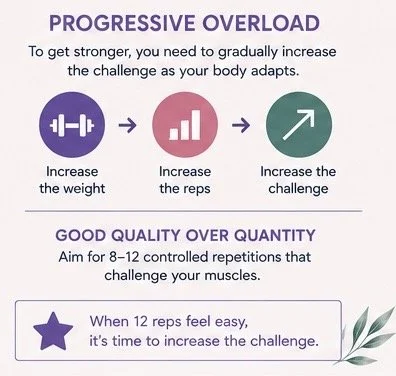
For many people, working towards a resistance where approximately 8–12 good-quality repetitions feel challenging can be a useful starting framework.
The Royal Osteoporosis Society recommends gradually progressing strength exercises and suggests increasing the resistance when 12 repetitions become easy.
That doesn't mean everyone should immediately start lifting heavy weights.
Start where you are and progress from there.
Technique, confidence and gradual progression matter.
How Often Should I Strength Train?
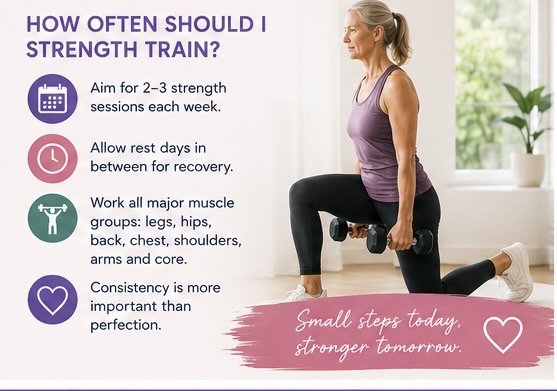
For most women, aiming for 2–3 strength sessions each week is a useful goal.
The Royal Osteoporosis Society recommends strength exercise on two to three days each week, allowing recovery between sessions.
You don't have to train every day.
In fact, recovery is part of becoming stronger.
A programme should ideally work the major muscle groups of your:
Legs
Hips
Back
Chest
Shoulders
Arms
Core
And it doesn't have to take hours.
Consistency matters far more than trying to create the “perfect” workout.
What Does Progressive Overload Mean?
This sounds complicated, but it's actually quite simple.
If you continually do exactly the same exercise with exactly the same resistance, your body eventually becomes used to it.
To continue adapting, we gradually increase the challenge.
That might mean:
5 kg → 6 kg → 7 kg
or
8 repetitions → 10 → 12
or progressing from:
Sit-to-stand → squat → weighted squat.
This is called progressive overload.
It doesn't mean pushing yourself to exhaustion every session.
It simply means gradually asking your body to do a little more as it becomes stronger.
Strength Training and Osteoporosis
Some women worry that lifting weights is dangerous if they have osteopenia or osteoporosis.
For most people, strength exercise can still be performed safely and is actively encouraged for bone health.
The important thing is choosing an appropriate level, using good technique and progressing gradually.
If you've had spinal fractures, multiple fragility fractures or have been diagnosed with significant osteoporosis, it's sensible to get individual advice before starting a new programme.
What About Impact Exercise?
Strength training is important, but when we're thinking specifically about bones, impact exercise can also be beneficial.
Depending on the individual, this might include:
Brisk walking
Stair climbing
Dancing
Jogging
Small jumps or hops
Racquet sports
The appropriate level depends on your existing bone health, joint health, fitness and previous injuries.
Not everybody needs—or should immediately start—jumping.
Again, exercise should be individualised rather than one-size-fits-all.
Can Strength Training Help With Weight Changes During Menopause?
Body composition often changes during perimenopause and menopause.
Some women notice an increase in abdominal fat while simultaneously losing muscle.
Strength training can help preserve or increase lean muscle mass and is an important part of managing body composition alongside nutrition, cardiovascular activity, sleep and overall lifestyle.
But I think there's an important shift in mindset here.
Instead of exercise being entirely about:
“How many calories did I burn?”
I'd rather women also ask:
“What am I doing today to make my body stronger for the next 20 or 30 years?”
That's a very different relationship with exercise.
What About HRT and Muscle Strength?
HRT has many established benefits for appropriate women experiencing menopausal symptoms, and it also protects against menopause-associated bone loss while treatment continues.
There is some evidence suggesting HRT may have a beneficial effect on muscle mass and strength, although NICE describes the evidence specifically for muscle strength as limited.
HRT and strength training shouldn't therefore be viewed as alternatives.
Exercise remains important whether or not you take HRT.
“I've Never Lifted Weights Before – Is It Too Late?”
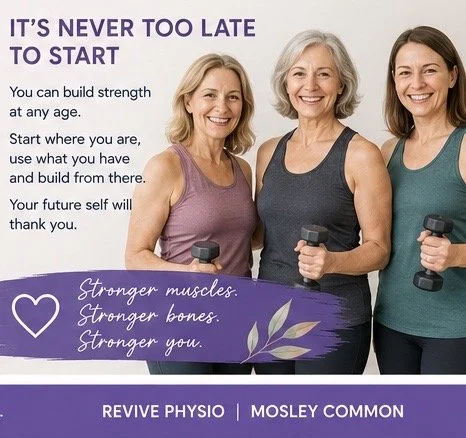
Absolutely not.
You can improve strength at almost any age.
You don't need to already be fit.
You don't need to know your way around a gym.
And you don't need to compare yourself with anybody else.
You simply start with what your body can comfortably manage today and build from there.
That might initially mean:
Getting out of a chair without using your hands
Performing a wall press
Using a resistance band
Holding a pair of light dumbbells
Doing a step-up
Over time, those exercises become easier.
Then we make them slightly harder.
That's how strength develops.
What If Exercise Hurts?
This is where physiotherapy can be particularly helpful.
Women sometimes tell me:
“I know I need to exercise, but every time I try something, something hurts.”
Maybe your knee stops you squatting.
Your shoulder hurts when you lift weights.
Your hip hurts after walking.
Or your Achilles complains when you start running.
The answer isn't necessarily to stop exercising altogether.
We need to work out:
What is causing the pain?
What can you currently tolerate?
What needs strengthening?
What needs modifying temporarily?
And then:
How can we gradually build you back up?
How Can Physiotherapy Help?
At Revive Physio, I don't believe in simply giving everyone the same sheet of exercises.
Your programme should reflect you.
A physiotherapy assessment can look at:
Muscle strength
Joint movement
Balance
Functional movement
Previous injuries
Current pain
Exercise experience
Menopausal symptoms
Your lifestyle
Most importantly—what you want to be able to do
From there we can develop a realistic programme that progresses as you get stronger.
For one woman, the goal might be getting comfortably up and down from the floor.
For another, it might be lifting heavier weights in the gym.
For somebody else, it might be returning to running, hiking or playing sport.
Strength is individual.
Strength Training Isn't About Becoming Smaller – It's About Becoming Stronger
Women have spent decades being encouraged to exercise primarily to change the size or shape of their bodies.
I think menopause is a great opportunity to change that conversation.
Exercise can be about:
Strong muscles.
Strong bones.
Healthy joints and tendons.
Better balance.
Confidence.
Independence.
And being physically capable of doing the things we want to do for many years to come.
Our bodies change during menopause.
But becoming weaker isn't something we simply have to accept.
Start Where You Are. Build From There.
You don't have to suddenly start lifting huge weights.
You don't need six gym sessions every week.
And you certainly don't have to be “good at exercise”.
Start with what you can do.
Build gradually.
Be consistent.
And give your body a reason to become stronger.
At Revive Physio, a specialist women's physiotherapy and wellbeing clinic in Mosley Common, I combine over 20 years of physiotherapy experience with my training as a Menopause Practitioner to help women understand their changing bodies and feel confident about exercise.
Because menopause isn't the time to stop challenging our bodies.
It's the time to invest in them.
Want to Feel Stronger but Don't Know Where to Start?
If joint pain, tendon problems, previous injuries or simply a lack of confidence are stopping you from exercising, a physiotherapy assessment can help.
Together we can identify what your body needs and develop a realistic strengthening plan that works for you.
Revive Physio | Mosley Common
Chartered Physiotherapist • Menopause Practitioner
Empower. Move. Thrive.