Menopause and Joint Pain: Why Do My Joints Suddenly Hurt?
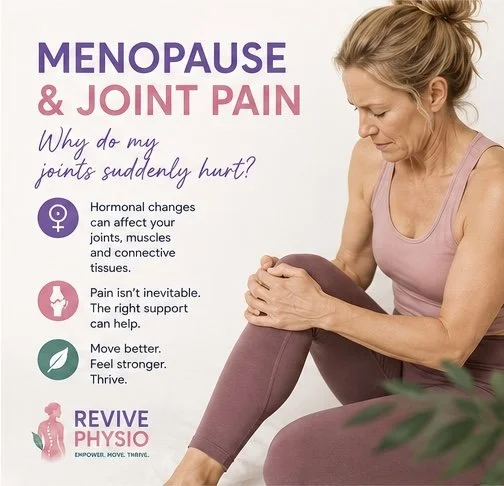
Are you in your 40s or 50s, in the midst of Perimenopause/Menopause and suddenly found that your body seems to ache more than it used to?
Maybe your knees feel stiff when you first stand up.
Your hips ache after sitting.
Your hands feel stiff in the morning.
Or perhaps you've developed aches in several joints without an obvious injury and you're wondering:
Joint and muscle pain are commonly reported during perimenopause and menopause, and changing hormone levels may be one of several factors contributing to these symptoms.
As both a Chartered Physiotherapist and Menopause Practitioner, I think it's really important that women understand this connection.
Because while our bodies undoubtedly change as we get older, that doesn't mean we simply have to accept pain and stop doing the things we enjoy.
Why Can Menopause Affect Our Joints?
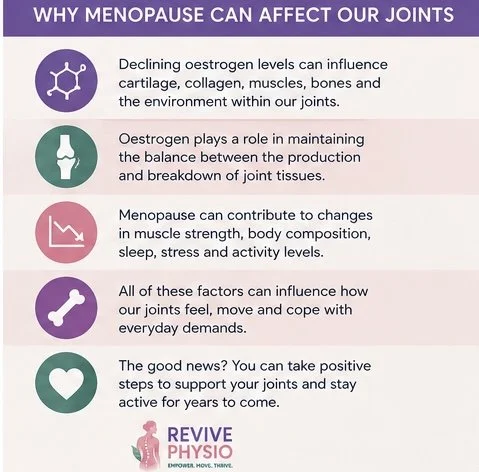
We tend to associate oestrogen with periods and reproductive health, but it has effects throughout the body – including within our bones, muscles and joints.
Oestrogen receptors are found within cartilage, synovial tissue and subchondral bone.
During perimenopause, oestrogen levels can fluctuate considerably before declining following menopause.
Research suggests oestrogen is involved in maintaining the balance between the production and breakdown of components of the cartilage matrix. When oestrogen declines, this balance may change, potentially contributing to cartilage degeneration and susceptibility to osteoarthritis.
This doesn't mean menopause automatically causes arthritis.
Joint health is influenced by many factors, including age, genetics, previous injury, muscle strength, activity, body composition and general health.
But hormonal changes appear to be another important part of the picture.
Oestrogen, Collagen and Your Joints
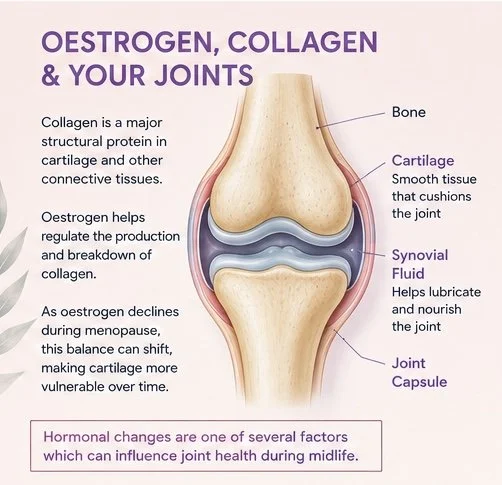
Collagen is one of the major structural building blocks of our musculoskeletal system.
It's found within our:
Cartilage
Tendons
Ligaments
Bone
Fascia and other connective tissues
Within articular cartilage, type II collagen forms an important structural framework that helps cartilage withstand the forces passing through our joints.
Oestrogen influences the cells responsible for maintaining cartilage and is involved in regulating the production and breakdown of collagen and other components of the cartilage matrix.
As oestrogen levels fall after menopause, this protective influence changes.
Research suggests oestrogen deficiency can alter cartilage metabolism, including increasing enzymes involved in breaking down type II collagen. However, the relationship in humans is complex and we're still learning exactly how hormonal changes influence the development and progression of osteoarthritis.
What Happens to Synovial Fluid?
This is another fascinating part of joint health that many people don't know about.
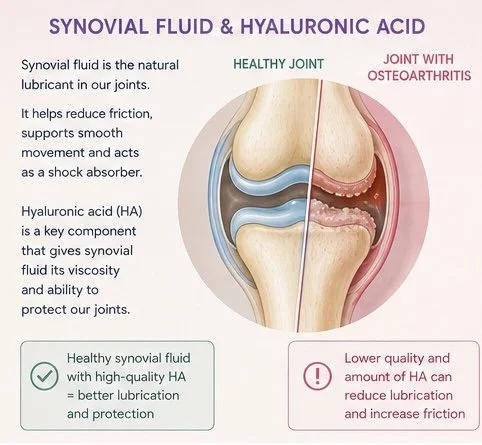
Most freely moving joints contain synovial fluid.
Think of it as part of your joint's natural lubrication system.
Synovial fluid helps:
Lubricate the joint
Reduce friction between joint surfaces
Support smooth movement
Help distribute forces through the joint
Support the environment in which cartilage functions
One of the really important components of synovial fluid is something called hyaluronic acid – or HA.
What Is Hyaluronic Acid?
You may recognise hyaluronic acid from skincare products, but we actually produce it naturally within our bodies.
Within a joint, HA contributes to the viscosity and elasticity of synovial fluid.
In simple terms, it helps our synovial fluid perform its lubricating and shock-absorbing functions.
As we age – and particularly in osteoarthritic joints – the composition and properties of synovial fluid can change.
This is why I prefer not to describe menopause as simply causing our joints to “dry out.”
It's more complicated than that.
We're looking at changes involving oestrogen, cartilage metabolism, collagen, muscle, bone and the quality of the environment within the joint.
And all of these can potentially influence how our joints feel and function.
Menopause doesn't simply make our joints “dry out”. Changes in oestrogen, cartilage, collagen and the joint environment may all contribute to how our joints feel during midlife.
What Does Menopause Joint Pain Feel Like?
There's no single pattern.
Some women describe a general aching feeling, almost as though their whole body suddenly hurts.
Others experience symptoms in particular joints.
You might notice:
Morning stiffness
Aching after sitting
Pain getting out of a chair
Knee pain on stairs
Hip pain or stiffness
Aching hips at night
Painful or stiff hands
Shoulder pain
Neck or back stiffness
Feeling much more sore after exercise than you used to
Sometimes women tell me their pain seems to move around from one area to another.
Is It Menopause or Osteoarthritis?
This is a question I hear frequently.
Osteoarthritis becomes increasingly common as we age, so menopausal musculoskeletal symptoms and osteoarthritis can overlap.
However, osteoarthritis isn't simply “wear and tear.”
It's a condition affecting the whole joint, including cartilage, bone, synovium and surrounding tissues.
Interestingly, the amount of arthritis visible on an X-ray doesn't necessarily correlate with how much pain somebody experiences.
You can have significant radiological changes and relatively little pain – or comparatively small changes and considerable symptoms.
That's why, as a physiotherapist, I treat the person rather than the scan.
Your strength, movement, previous injuries, lifestyle, activity, sleep and goals all matter.
Why Might Joint Pain Feel Worse During Menopause?
Hormonal changes aren't the only thing happening during midlife.
Reduced muscle strength
Muscle mass and strength tend to decline as we age, and menopause-associated hormonal changes can contribute to changes in body composition.
Less muscle strength can reduce our ability to manage forces around our joints.
Reduced activity
This can become a vicious cycle.
Pain → less movement → reduced strength and capacity → activity feels harder → more pain.
One of our goals in physiotherapy is to break that cycle.
Poor sleep
Hot flushes, night sweats and insomnia can significantly affect sleep during perimenopause and menopause.
Poor sleep affects recovery and can also increase our sensitivity to pain.
Changes in body composition
Changes in weight and body composition can affect the mechanical load through weight-bearing joints such as the knees and hips.
However, weight is only one factor. Strength, fitness, hormones, previous injury, sleep and genetics all matter too.
Should I Stop Exercising If My Joints Hurt?
Usually, no.
Appropriate exercise is actually one of the most important things we can do for our joints, muscles and bones during menopause.
Exercise can improve:
Muscle strength
Joint function
Bone health
Balance
Cardiovascular fitness
Sleep
Mood
Confidence
Our ability to keep doing the things we love
The key isn't necessarily exercising less.
It's finding the right type, amount and progression of exercise for your body.
Strength Training During Menopause
If I could encourage women in midlife to incorporate one form of exercise consistently, resistance training would be very high on my list.
Strong muscles help support our joints and improve our ability to cope with everyday and sporting activities.
Depending on your starting point, this might include:
Squats
Sit-to-stands
Step-ups
Resistance bands
Dumbbells
Gym machines
Bodyweight exercises
You don't have to become a weightlifter.
You simply need enough resistance to challenge your muscles and gradually progress as you become stronger.
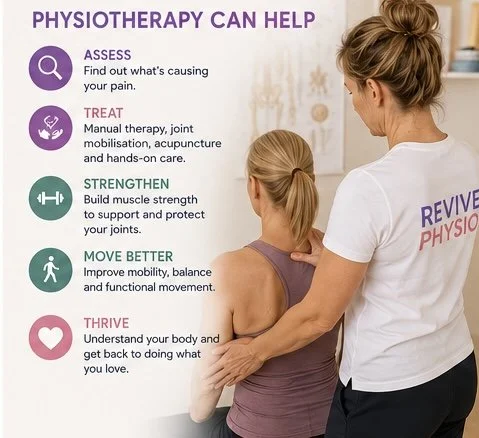
How Can Physiotherapy Help?
The first thing I want to establish when somebody comes to see me is:
What's actually causing the pain?
Not all knee pain is arthritis.
Not all hip pain comes from the hip joint.
Not all shoulder pain comes from the shoulder.
And not every ache you develop in your 40s or 50s is caused by menopause.
A physiotherapy assessment can look at your:
Joint movement
Muscle strength
Functional movement
Balance
Flexibility
Activity levels
Exercise
Previous injuries
Lifestyle and recovery
Menopausal symptoms where relevant
Treatment may then include:
Individualised strengthening
Mobility exercises
Manual therapy
Joint mobilisation
Soft tissue treatment
Acupuncture where appropriate
Exercise modification
Education and self-management
Gradual return to exercise and activity
The goal isn't simply to make something feel better temporarily.
It's to understand why you're hurting and improve your body's ability to cope with the things you want it to do.
What About Hyaluronic Acid Injections?
This is where understanding the role of naturally occurring HA within our joints becomes particularly useful.
For some people with persistent joint pain – particularly osteoarthritis of the knee – hyaluronic acid injection therapy may be another treatment option.
Hyaluronic acid injections are sometimes referred to as viscosupplementation.
HA is injected directly into the affected joint with the aim of supplementing the hyaluronic acid already present within the joint.
For appropriately selected patients, HA injections may help:
Reduce pain
Reduce stiffness
Improve function
Make walking and everyday activities easier
Make exercise and rehabilitation more comfortable
The response varies between individuals, so an injection can't guarantee pain relief.
Hyaluronic Acid Isn't Simply “Replacing Lost Fluid”
This is an important distinction.
Sometimes HA injections are described as “putting lubrication back into the joint.”
That's an easy analogy to understand, but biologically it's more complicated.
We're not simply filling up a joint that's run out of fluid.
We're supplementing an important naturally occurring component of the joint environment.
And that makes much more sense when you understand the wider picture:
Oestrogen → cartilage and collagen metabolism → changing joint environment → pain and function → rehabilitation ± injection therapy.
Is HA the Same as a Steroid Injection?
No.
They're very different treatments.
A corticosteroid injection is primarily used for its anti-inflammatory effect and may provide relatively rapid symptom relief in certain conditions.
Hyaluronic acid isn't a steroid.
Its effects may take longer to develop and it is particularly used in the management of osteoarthritis.
Neither injection is automatically the right answer.
Which treatment – if either – is appropriate depends on the diagnosis, symptoms, medical history and what we're trying to achieve.
When Should Joint Pain Be Assessed?
Consider getting your joint pain assessed if it:
Persists for several weeks
Is progressively worsening
Regularly wakes you at night
Limits your walking or exercise
Causes significant stiffness
Keeps returning
Is affecting your work or everyday activities
Seek medical advice promptly for a hot, significantly swollen or red joint, unexplained fever or illness with joint symptoms, significant trauma, inability to bear weight or rapidly worsening symptoms.
Menopause Doesn't Mean Your Best Years of Movement Are Behind You
Our bodies change during perimenopause and menopause.
Our hormones change.
Our muscle and bone health changes.
And the tissues within our joints change too.
But that doesn't mean becoming painful, weak or inactive is inevitable.
Understanding what's happening and using the right combination of movement, strengthening, lifestyle support, physiotherapy and, where clinically appropriate, injection therapy can make a significant difference.
At Revive Physio in Mosley Common, I combine over 20 years of physiotherapy experience with my training as a Menopause Practitioner and Injection Therapist.
That means I can look at the whole picture – not simply the painful joint.
Because sometimes the answer isn't:
“You're just getting older.”
It's:
“Let's work out what's changed and what we can do about it.”
Struggling With Joint Pain During Perimenopause or Menopause?
If painful knees, hips, shoulders, hands or other joints are stopping you doing the things you enjoy, you don't simply have to put up with them.
At Revive Physio, I can assess your symptoms and develop an individual treatment plan including physiotherapy, strengthening and, where clinically appropriate, hyaluronic acid injection therapy.
Revive Physio | Mosley Common
Chartered Physiotherapist • Menopause Practitioner • Injection Therapist
Empower. Move. Thrive.