Menopause and Tendon Problems: Why Tendon Pain Can Become More Common in Midlife
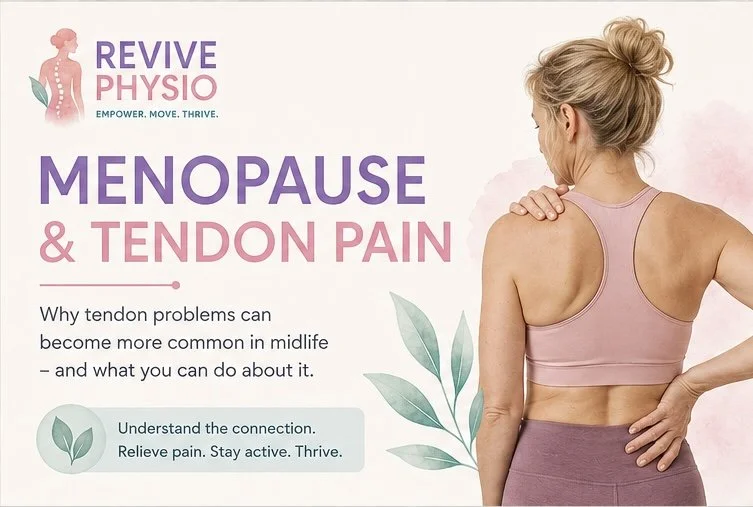
Have you reached your 40s or 50s and suddenly found yourself dealing with injuries you’ve never had before?
Perhaps your shoulder has become painful, your Achilles is complaining when you run, your elbow hurts when you lift something, or you’ve developed persistent pain around the outside of your hip.
You may have been told it's simply ageing or wear and tear.
But there may be another factor worth considering: perimenopause and menopause.
As a Chartered Physiotherapist and Menopause Practitioner, I see many women who develop new or recurrent tendon problems during midlife. Hormonal changes aren't necessarily the sole cause of these problems, but declining and fluctuating oestrogen levels may affect the health and resilience of our tendons.
What is a tendon?
Tendons are strong bands of connective tissue that attach our muscles to our bones.
Every time we walk, run, climb stairs, lift weights or simply move our arms and legs, our tendons help transfer force from our muscles to our skeleton.
Healthy tendons are incredibly strong and adaptable. When we exercise, they respond to load by becoming stronger.
However, if the amount of load placed through a tendon becomes greater than its current capacity to tolerate it, the tendon can become painful and irritated.
This is known as tendinopathy.
What does menopause have to do with our tendons?
One of the biggest hormonal changes during perimenopause and menopause is the fluctuation and eventual decline in oestrogen.
Most people associate oestrogen with periods and reproductive health, but oestrogen has effects throughout the body—including our muscles, bones and connective tissues.
Our tendons are made predominantly from collagen, and oestrogen is involved in collagen turnover and the way connective tissues respond to load.
As oestrogen levels change, there may be changes in tendon structure, stiffness and the body's ability to adapt and recover.
This doesn't mean menopause automatically causes tendinopathy.
Instead, it may be one part of the picture that makes some women more susceptible to tendon pain, particularly when combined with changes in activity, muscle strength, sleep, recovery and body composition.
Which tendon problems are common around menopause?
There are several conditions I commonly see in women during their 40s, 50s and beyond.
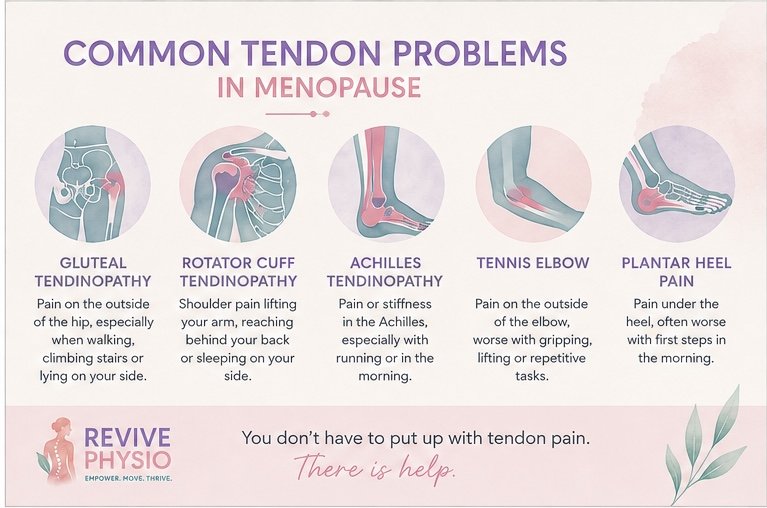
Gluteal tendinopathy
Pain around the outside of the hip is extremely common in midlife women.
You may notice:
Pain lying on your affected side
Pain walking upstairs
Pain after longer walks
Difficulty standing on one leg
Pain getting out of the car
Tenderness over the outside of your hip
This is sometimes incorrectly described simply as hip bursitis, when the gluteal tendons may also be involved.
Rotator cuff tendinopathy
The rotator cuff is a group of muscles and tendons that help control your shoulder.
Symptoms can include:
Pain lifting your arm
Pain reaching behind your back
Difficulty putting on a bra or coat
Pain sleeping on the affected shoulder
Pain lifting weights or carrying shopping
Shoulder problems, including rotator cuff conditions and frozen shoulder, are frequently seen in women around midlife.
Achilles tendinopathy
The Achilles tendon connects your calf muscles to your heel.
Pain may develop after increasing your walking, running or exercise, and symptoms often include:
Pain or stiffness first thing in the morning
Pain when starting to walk
Pain running
Tenderness around the Achilles
Stiffness after sitting for a while
Tennis elbow
You don't need to play tennis to develop tennis elbow!
Pain is usually felt around the outside of the elbow and may be aggravated by:
Lifting
Gripping
Carrying bags
Using a mouse
Gym exercises
Gardening
Household tasks
Plantar FASCIITIS &heel pain
Although the plantar fascia isn't technically a tendon, plantar heel pain is another condition frequently experienced by women in midlife.
Pain is often worse with the first few steps in the morning or after sitting for a while.
Why might tendon problems suddenly appear?
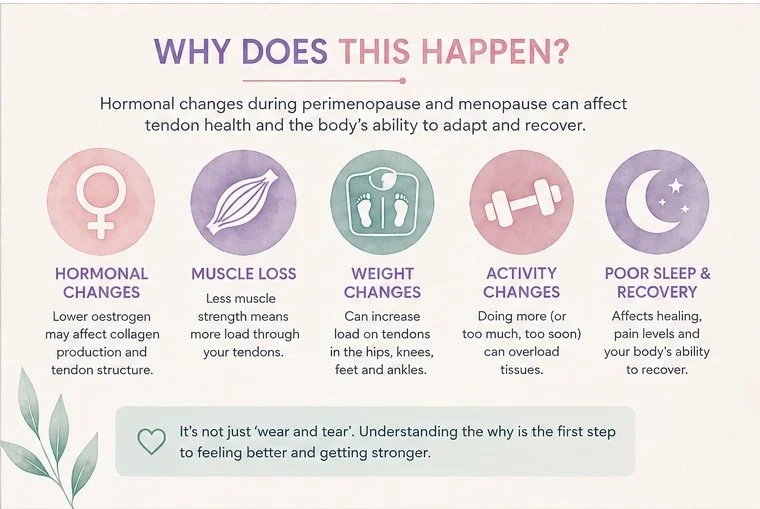
Hormones are only one part of the story.
I often explain to patients that tendon pain is about the relationship between load and capacity.
Your tendon has a certain capacity to cope with load.
If the demands placed upon it suddenly exceed that capacity, symptoms may develop.
During perimenopause and menopause, several things can influence this balance:
Hormonal changes may affect connective tissue and recovery.
Loss of muscle mass and strength can mean more load is transferred through other structures.
Poor sleep can affect recovery and our perception of pain.
Weight changes can increase mechanical load through the hips, knees, feet and Achilles.
Changes in exercise can be another trigger. Many women understandably decide during midlife that they want to become fitter, start running, increase their steps or begin strength training. These are fantastic things to do—but progressing too quickly can overload tissues that aren't yet conditioned for that activity.
The answer isn't to stop exercising.
Usually, it's about finding the right amount of exercise and gradually building capacity.
Should I rest a painful tendon?
Complete rest is rarely the long-term answer for tendinopathy.
Rest may temporarily reduce pain, but if you completely stop loading a tendon, its capacity to tolerate activity can reduce further.
Then, when you return to normal activity, the pain may simply come back.
Instead, rehabilitation usually involves gradually and progressively loading the tendon.
The exact exercises depend on the tendon involved, your symptoms, your strength and the activities you want to return to.
Why strength training becomes even more important during menopause
Strength training is one of the most useful things women can do during and after menopause.
It can help maintain or improve:
Muscle mass
Muscle strength
Tendon capacity
Bone health
Balance
Function
Confidence with movement
You don't necessarily need to spend hours in a gym.
The important thing is that the exercise provides enough resistance to stimulate your muscles and is gradually progressed over time.
For someone with tendinopathy, however, the programme may need adapting initially so that the tendon receives enough load to encourage adaptation without repeatedly aggravating it.
Can HRT help tendon problems?
This is a question I am increasingly asked.
HRT replaces some of the hormones that decline during menopause, particularly oestrogen.
There is biological evidence suggesting oestrogen influences collagen and tendon health, but research into whether HRT can prevent or treat specific tendon problems is still developing.
Some women report improvements in their general joint and muscle symptoms after starting HRT, and HRT has established benefits for menopausal symptoms and bone health in appropriate women.
However, HRT shouldn't be considered a standalone treatment for tendinopathy.
If you have a painful tendon, rehabilitation and appropriate progressive loading remain important.
The decision to start HRT should also be based on your overall menopausal symptoms, health, individual risk factors and preferences and discussed with an appropriately qualified healthcare professional.
How can physiotherapy help?
The first step is making sure we know what is actually causing your pain.
Not every pain around a tendon is tendinopathy.
For example, pain around the shoulder can originate from the shoulder itself or sometimes the neck. Hip pain can arise from the hip joint, gluteal tendons or lower back. Heel pain can have several different causes.
That's why a thorough assessment is important.
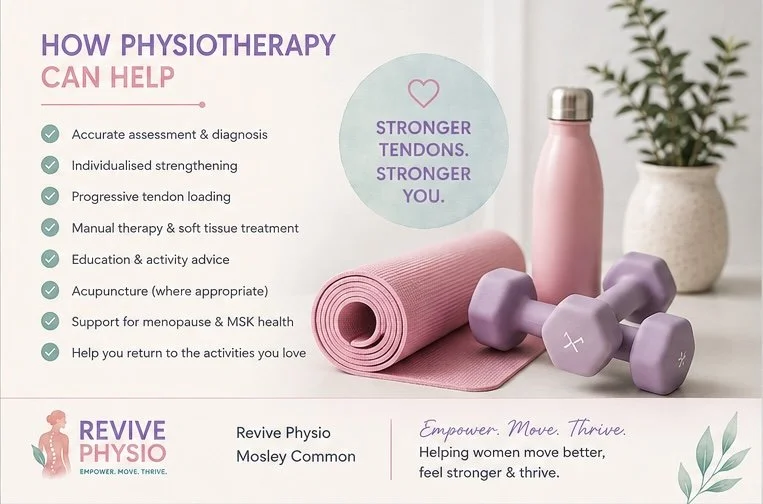
At Revive Physio, treatment may include:
A detailed assessment and diagnosis
Strength and movement testing
Individualised rehabilitation exercises
Progressive tendon loading
Advice around exercise and activity
Manual therapy where appropriate
Acupuncture where appropriate
Hyaluronic acid injections
Education about pain and recovery
Advice around menopause and musculoskeletal health
A gradual return to running, gym or sport
Rather than simply treating where it hurts, we look at why the problem developed and what needs to change to reduce the chance of it returning.
Hyaluronic Acid Injections for Tendon Pain?
Hyaluronic acid injections are probably best known for their use in osteoarthritis, but they are also increasingly being used in the management of some tendon problems and tendinopathies.
Hyaluronic acid occurs naturally within the body and is found not only within our joints but also in the tissues surrounding tendons. It plays a role in lubrication, tissue movement and the biological environment in which tendons heal and adapt.
Research into hyaluronic acid for tendinopathy is still developing, but studies suggest that injections may help reduce pain and improve function in certain tendon conditions.
These may include conditions such as:
Rotator cuff tendinopathy
Tennis elbow (lateral epicondylalgia)
Patellar tendinopathy
Trigger finger
Achilles tendinopathy
Trochanteric bursitis
De Quervains Tenosynovitis
Golfers elbow
Some other persistent tendon problems
For women experiencing persistent tendon pain during perimenopause or menopause, this may provide an additional treatment option when symptoms aren't improving as expected with rehabilitation alone.
Why might hyaluronic acid help?
Hyaluronic acid may help create a more favourable environment around the tendon, potentially improving tendon gliding and influencing inflammation and tissue healing.
For some patients, reducing pain can also make it easier to progress strengthening and tendon-loading exercises, which remain an important part of successful tendinopathy rehabilitation.
It's not an injection instead of physiotherapy
This is really important.
I don't see injections and physiotherapy as an either/or treatment.
If I feel a hyaluronic acid injection may be appropriate, it would usually form part of a wider rehabilitation plan.
The aim is to reduce pain sufficiently to allow us to progressively strengthen the tendon, improve its capacity to tolerate load and ultimately get you back to the activities you want to do.
Not every tendon problem needs an injection, and not every patient will be suitable. A thorough assessment and accurate diagnosis should always come first.
At Revive Physio, I can assess your tendon problem, discuss your treatment options and, where clinically appropriate, offer hyaluronic acid injection therapy alongside your rehabilitation.
The goal isn't simply to settle the pain—it's to build a stronger, more resilient tendon and help you stay active for the long term.
When should you seek help?
Consider having your symptoms assessed if your tendon pain:
Has persisted for several weeks
Keeps returning
Is stopping you exercising
Is affecting your sleep
Is becoming progressively worse
Isn't improving despite resting
Is affecting your everyday activities
And if you suddenly experience severe pain, significant swelling, bruising, weakness or felt a snap or pop, seek medical assessment promptly as this can indicate a more significant tendon injury.
Menopause doesn't mean you have to stop doing the things you love
One of the messages I'm passionate about as both a physiotherapist and menopause practitioner is that midlife shouldn't mean becoming less active because everything hurts.
Our bodies do change during menopause, and understanding those changes matters.
But tendons are also adaptable.
With the right diagnosis, appropriate loading, strength work and support, many tendon problems can be successfully managed.
At Revive Physio in Mosley Common, I combine over 20 years of physiotherapy experience with menopause knowledge to help women understand what's happening to their bodies and, importantly, what they can do about it.
My aim is to help you move better, feel stronger and thrive.
Struggling with persistent tendon pain?
If shoulder, elbow, hip, Achilles or heel pain is stopping you doing the things you enjoy, you don't simply have to put up with it.
A physiotherapy assessment can help identify the cause and give you a clear plan to get stronger and back to the activities you love.
Revive Physio | Mosley Common, Worsley.